Essential Elements of a Valid Contract (2026): Complete ICA Guide With Examples
Reviewed by Lawsection.in Editorial Team | May 21, 2026
The essential elements of a valid contract under the Indian Contract Act, 1872 form the foundation of Indian contract law. Every law student, judiciary aspirant, AIBE candidate, and legal professional must clearly understand these essentials because only legally enforceable agreements become valid contracts under Section 10 of the ICA.
For judiciary aspirants, AIBE candidates, CLAT PG students, law school examinations, and young legal professionals, understanding the essential elements of a valid contract is one of the most important and repeatedly tested topics.
This complete guide from our “Law Notes” hub explains every essential element with:
- Bare Act understanding
- Landmark case laws
- Practical examples
- MCQ-oriented concepts
- Judiciary exam notes
- Common mistakes in exams
- Updated legal position as of May 2026
What Are the Essential Elements of a Valid Contract?
Under Section 10 of the Indian Contract Act, 1872, the essential elements of a valid contract are:
- Offer and Acceptance
- Intention to Create Legal Relations
- Lawful Consideration
- Competency of Parties
- Free Consent
- Lawful Object
- Certainty of Terms
- Possibility of Performance
- Agreements Not Expressly Declared Void
- Compliance with Legal Formalities (where required)
If any essential element is missing, the agreement may become void, voidable, or unenforceable.
Meaning of Contract Under the Indian Contract Act, 1872
Section 2(h) of the Indian Contract Act states:
“An agreement enforceable by law is a contract.”
Thus:
Contract=Agreement+Enforceability by Law
An agreement becomes a contract only when legal requirements are fulfilled.
Difference Between Agreement and Contract
| Basis | Agreement | Contract |
|---|---|---|
| Meaning | Promise between parties | Legally enforceable agreement |
| Legal Enforceability | May or may not be enforceable | Always enforceable |
| Defined Under | Section 2(e) | Section 2(h) |
| Example | Social promise | Business transaction |
Example
Rahul promises to take Aman for dinner.
This is only a social agreement, not a contract.
But if Rahul agrees to sell his bike to Aman for ₹50,000 and Aman accepts, it becomes a contractual agreement.
Essential Elements of a Valid Contract under Indian Law
1. Offer and Acceptance
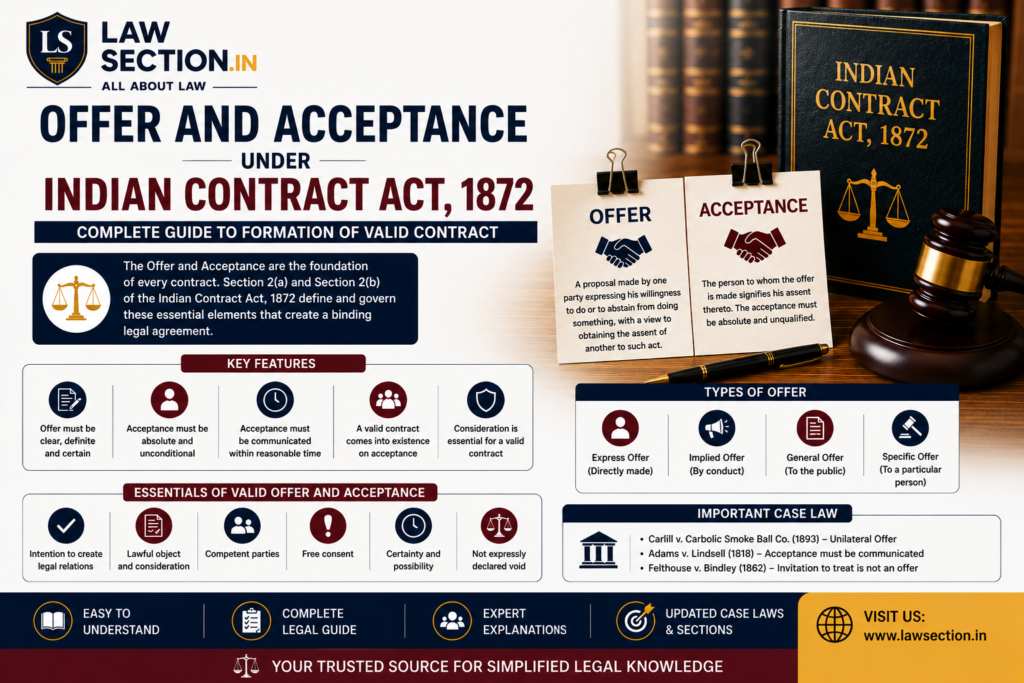
A valid contract begins with a lawful offer and lawful acceptance.
Offer
Defined under Section 2(a).
An offer means willingness to do or abstain from doing something with the intention of obtaining assent.
Acceptance
Defined under Section 2(b).
Acceptance occurs when the person to whom the proposal is made gives assent.
Essentials of Valid Acceptance
- Must be absolute and unqualified
- Must be communicated
- Must be according to prescribed mode
- Must be given by authorized person
Example
A offers to sell his laptop to B for ₹40,000.
B says “I accept.”
This creates a promise.
Important Case Law
Carlill v. Carbolic Smoke Ball Co. (1893)
Established validity of general offers to the public
2. Intention to Create Legal Relationship
The parties must intend legal consequences.
Social or domestic arrangements generally do not create contracts.
Example
A husband promises to gift jewellery to his wife.
Normally not enforceable.
But commercial agreements are presumed to create legal obligations.
Landmark Case
Balfour v. Balfour (1919)
Domestic agreements are generally not contracts.
3. Lawful Consideration
Consideration means “something in return.”
Section 2(d) defines consideration.
No Consideration⇒No Contract
Essentials of Consideration
- Must move at desire of promisor
- May move from promisee or third party
- Must be lawful
- Need not be adequate
- Must be real and possible
Example
A agrees to paint B’s house for ₹20,000.
Painting = consideration by A
Money = consideration by B
Exceptions to “No Consideration No Contract”
Under Section 25:
- Natural love and affection
- Past voluntary services
- Promise to pay time-barred debt
Important Case Law
Chinnaya v. Ramayya (1882)
Consideration may move from a third party.
4. Competency of Parties
Under Section 11, parties must be competent to contract.
A person is competent if:
- Major
- Of sound mind
- Not disqualified by law
Minor’s Agreement
A minor’s agreement is void ab initio.
Landmark Case
Mohori Bibee v. Dharmodas Ghose (1903)
The Privy Council held:
Agreement with minor is absolutely void.
Persons Disqualified by Law
- Foreign sovereigns (subject to conditions)
- Alien enemies
- Convicts
- Insolvents
5. Free Consent
Consent means parties agreeing upon the same thing in the same sense.
This is known as:
Consensus ad idem
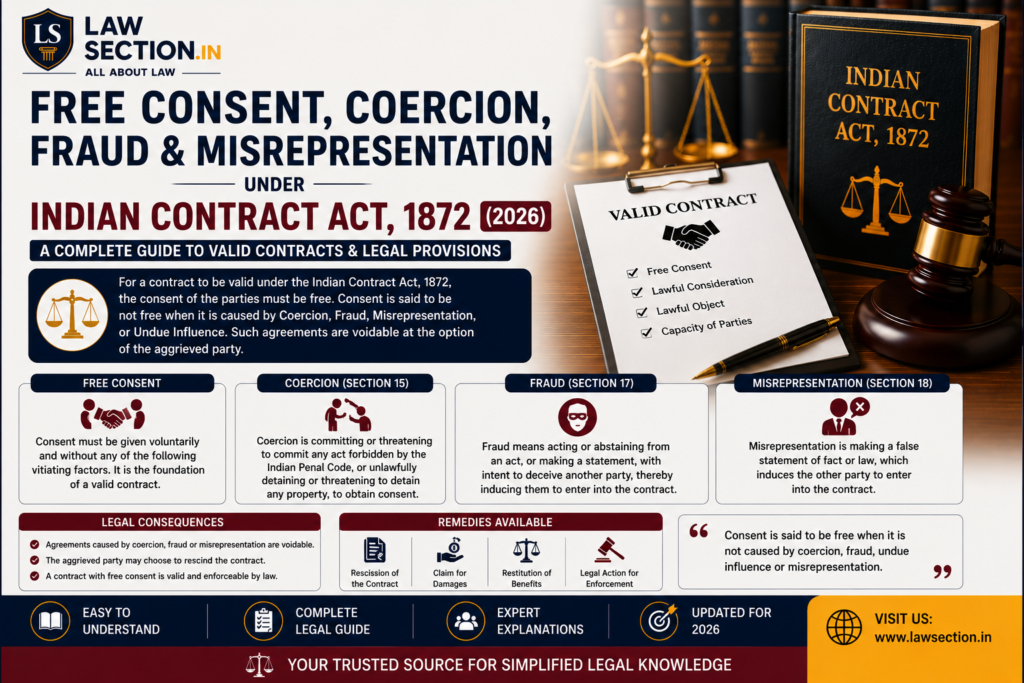
Under Section 14, consent is free when not caused by:
- Coercion
- Undue influence
- Fraud
- Misrepresentation
- Mistake
Coercion
Defined under Section 15.
Committing or threatening any act forbidden by IPC/BNS to compel agreement.
Example
Threatening to assault someone unless they sign a contract.
Undue Influence
Section 16.
One party dominates the will of another.
Example
Doctor influencing patient unfairly.
Fraud
Section 17.
Intentional deception to induce contract.
Example
Selling fake gold as real gold.
Misrepresentation
Section 18.
False statement made innocently.
Mistake
Mistake may be:
- Mistake of fact
- Mistake of law
Bilateral mistake of fact makes agreement void.
Landmark Case
Raffles v. Wichelhaus (1864)
No consensus ad idem due to misunderstanding.
6. Lawful Object
Under Section 23, object must be lawful.
Object becomes unlawful if:
- Forbidden by law
- Fraudulent
- Immoral
- Opposed to public policy
- Defeats provisions of law
Example
Agreement for smuggling goods is void and illegal.
7. Certainty of Terms
Section 29 states agreements with uncertain meaning are void.
Example
“I will sell you one car at reasonable price.”
Uncertain because no definite terms.
8. Possibility of Performance
Section 56:
Impossible acts cannot become contracts.
Impossible Agreement⇒Void
Example
Agreement to bring a dead person back to life is void.
Landmark Case
Taylor v. Caldwell (1863)
Doctrine of frustration recognized.
9. Agreements Not Expressly Declared Void
Certain agreements are specifically declared void under ICA:
- Restraint of marriage
- Restraint of trade
- Restraint of legal proceedings
- Wagering agreements
Wagering Agreement
A wagering agreement depends on uncertain future events where neither party has control.
Example
Betting on cricket match result.
10. Legal Formalities
Some contracts require:
- Writing
- Registration
- Attestation
Examples
- Sale of immovable property
- Gift deeds
- Mortgages
Flowchart: Essentials of Valid Contract
| Essential | Relevant Section |
|---|---|
| Offer & Acceptance | Sections 2(a), 2(b) |
| Intention | Judicial principle |
| Consideration | Section 2(d) |
| Competency | Section 11 |
| Free Consent | Section 14 |
| Lawful Object | Section 23 |
| Certainty | Section 29 |
| Possibility | Section 56 |
| Not Void | Various provisions |
| Legal Formalities | Specific laws |
Judiciary & AIBE Exam-Oriented Notes
Most Important Sections
- Section 10
- Section 11
- Section 14
- Section 23
- Section 25
- Section 29
- Section 56
Difference Between Void, Voidable and Illegal Agreements
| Type | Meaning | Enforceability |
|---|---|---|
| Void | Not enforceable | No |
| Voidable | Enforceable at option of one party | Conditional |
| Illegal | Forbidden by law | No |
People Also Ask
Memory Trick for Essentials of Valid Contract
Use:
“OIL C-FLAP”
- O → Offer & Acceptance
- I → Intention
- L → Lawful consideration
- C → Competency
- F → Free consent
- L → Lawful object
- A → Agreement not void
- P → Possibility & certainty
Quick Revision Box
| Topic | Key Point |
|---|---|
| Section 10 | Essentials of valid contract |
| Section 11 | Competency |
| Section 14 | Free consent |
| Section 23 | Lawful object |
| Section 25 | Exceptions to consideration |
| Section 29 | Uncertain agreements void |
| Section 56 | Impossible agreements void |
Frequently Asked Questions (FAQs)
What are the essential elements of a valid contract under the Indian Contract Act, 1872?
The essential elements include offer and acceptance, lawful consideration, free consent, competent parties, lawful object, certainty, and possibility of performance.
Is every agreement considered a contract in India?
No. Every agreement is not a contract. Only agreements enforceable by law become valid contracts under Section 2(h) of the Indian Contract Act, 1872.
Can a contract be valid without free consent?
No. If consent is obtained through coercion, fraud, undue influence, or misrepresentation, the contract may become voidable.
Why is consideration important in a contract?
Consideration is the value exchanged between parties. Without lawful consideration, a contract is generally void unless it falls under Section 25 exceptions.
What happens if the object of a contract is illegal?
If the object or purpose of a contract is unlawful or opposed to public policy, the agreement becomes void and unenforceable in court.
Conclusion
The topic “Essential Elements of a Valid Contract” is the backbone of the Indian Contract Act, 1872 and one of the most important subjects for:
- Judiciary exams
- AIBE
- CLAT PG
- UGC NET LAW
- Law school semester exams
- Legal drafting and litigation practice
A contract becomes legally enforceable only when every statutory requirement under Section 10 is satisfied.
For conceptual clarity, always remember:
- Agreement alone is not enough
- Enforceability is the soul of contract law
- Free consent and lawful object are indispensable
- Void agreements can never become contracts