Offer and Acceptance under Indian Contract Act, 1872
Reviewed by Lawsection.in Editorial Team | May 22, 2026
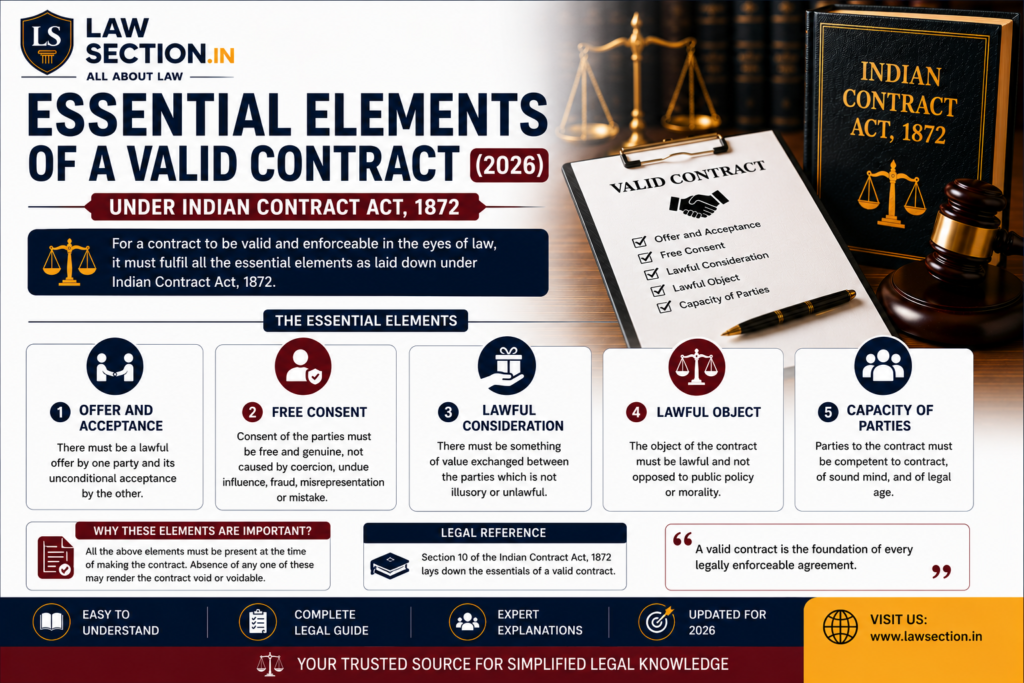
Offer and Acceptance are the foundation of every valid contract under the Indian Contract Act, 1872. Understanding the rules, essentials, communication, revocation, and landmark cases related to offer and acceptance is extremely important for Judiciary exams, AIBE, CLAT PG, UGC NET LAW, and practical legal drafting.
For Judiciary exams, AIBE, CLAT PG, UGC NET LAW, university exams, and practical legal drafting, this topic is one of the highest-weightage areas under Contract Law.
In this complete 2026 guide, you will learn:
- Meaning and essentials of offer and acceptance
- Sections 2(a), 2(b), 3, 4, 5, 6, 7 and 8 explained
- Types of offers under Indian law
- Rules of valid acceptance
- Communication and revocation rules
- Postal rule and electronic communication
- Landmark Supreme Court and English cases
- Exam-oriented illustrations and MCQs concepts
- Frequently asked questions for Judiciary and AIBE
This article is part of our “Law Notes” Hub covering complete Contract Law notes, case laws, bare act interpretation, and exam-focused legal concepts.
What is Offer and Acceptance under Indian Contract Act?
Under the Indian Contract Act, 1872, an “offer” or “proposal” means a willingness by one person to do or abstain from doing something to obtain the assent of another person. When the other person gives assent to that proposal, it becomes “acceptance.” Together, offer and acceptance create an agreement enforceable by law if other essentials of a valid contract are fulfilled.
Offer and Acceptance under Contract Law
An offer is the starting point of a contract. It expresses readiness to enter into a legal relationship on certain terms.
Example
A says to B:
“I will sell my car to you for ₹5 lakh.”
This is an offer.
If B says “Yes, I agree,” acceptance takes place and an agreement is formed.
Statutory Provisions Related to Offer and Acceptance
Section 2(a) — Proposal / Offer
According to Section 2(a):
When one person signifies to another his willingness to do or abstain from doing anything, with a view to obtaining the assent of that other person, he is said to make a proposal.
Important Elements
- There must be a willingness
- Communication must be made to another person
- Intention must be to obtain assent
- It may involve doing or abstaining from doing something
Section 2(b) — Acceptance
When the person to whom the proposal is made signifies his assent thereto, the proposal is said to be accepted.
Once accepted, a proposal becomes a promise.
Essential Elements of a Valid Offer
1. Offer Must Show Intention to Create Legal Relations
The offeror must intend legal consequences.
Example
Invitation to dinner is generally social and not legally enforceable
2. Offer Must Be Certain and Definite
Uncertain or vague offers are invalid.
Case Law
Scammell v. Ouston
An agreement with uncertain hire-purchase terms was held void for uncertainty.
3. Offer Must Be Communicated
An uncommunicated offer cannot be accepted.
Landmark Case
Lalman Shukla v. Gauri Dutt
Principle
A servant who found a missing boy without knowledge of reward could not claim reward later because the offer was not communicated to him.
4. Offer May Be Express or Implied
Express Offer
Made by words spoken or written.
Implied Offer
Inferred from conduct.
Example
A bus operating for passengers implies willingness to carry passengers for fare.
5. Offer Must Be Made with a View to Obtain Assent
Mere statement of intention is not an offer.
Types of Offer under Indian Contract Act
1. General Offer
Offer made to the public at large.
Landmark Case
Carlill v. Carbolic Smoke Ball Co.
Facts
Company promised £100 reward to anyone who used smoke ball and still contracted influenza.
Held
General offer can be accepted by anyone who fulfills conditions.
Importance
Most important case on unilateral contracts and general offer.
2. Specific Offer
Made to a particular person or group.
Only those persons can accept it.
3. Cross Offer
Two identical offers made by parties unaware of each other’s offers.
Example
A writes offering to sell goods for ₹50,000. Simultaneously B writes offering to buy goods for ₹50,000.
No contract arises because there is no acceptance.
4. Counter Offer
Acceptance with modifications.
Landmark Case
Hyde v. Wrench
Counter-offer destroys original offer.
5. Standing / Open / Continuing Offer
Offer that remains open for acceptance over time.
Example
Tender contracts.
Invitation to Offer vs Offer
This is one of the most important exam topics.
| Basis | Offer | Invitation to Offer |
|---|---|---|
| Meaning | Final willingness | Invitation to negotiate |
| Legal Effect | Can create contract upon acceptance | Cannot create contract directly |
| Example | Offer to sell bike | Goods displayed in shop |
Landmark Cases on Invitation to Offer
Pharmaceutical Society of Great Britain v. Boots Cash Chemists
Goods displayed on shelves are invitation to offer, not actual offer.
Fisher v. Bell
Display of knife in shop window was invitation to offer.
Meaning of Acceptance
Acceptance means giving assent to the offer.
A proposal becomes legally binding once the other party accepts it lawfully.
Essentials of Valid Acceptance
1. Acceptance Must Be Absolute and Unqualified
Section 7 requires acceptance to match the offer exactly.
Example
A offers to sell car for ₹5 lakh.
B says: “I will buy for ₹4.5 lakh.”
This is counter-offer, not acceptance..
2. Acceptance Must Be Communicated
Mental acceptance is not enough.
Landmark Case
Felthouse v. Bindley
Silence does not amount to acceptance.
3. Acceptance Must Be Made in Prescribed Mode
If proposer prescribes manner, it should generally be followed.
4. Acceptance Must Be Given Before Lapse of Offer
Acceptance after lapse is invalid.
5. Acceptance Must Be Given by Proper Person
Specific offers can only be accepted by intended person.
6. Acceptance Must Be Legal
Illegal acceptance cannot form valid contract.
Communication of Offer and Acceptance
Sections 3 and 4 govern communication.
Communication of Offer
Communication completes when it comes to knowledge of offeree.
Communication of Acceptance
Against Proposer
Complete when acceptance is put into transmission beyond acceptor’s control.
Against Acceptor
Complete when acceptance comes to proposer’s knowledge.
Postal Rule under Indian Contract Law
The postal rule creates a contract when acceptance is posted.
Example
A posts offer on 1 June.
B posts acceptance on 5 June.
Contract forms on 5 June against proposer.
Revocation of Offer and Acceptance
Governed by Sections 5 and 6.
Revocation of Offer
The offeree must communicate acceptance before the offer is revoked.
Revocation of Acceptance
Acceptance may be revoked before communication becomes complete against acceptor.
Modes of Revocation of Offer
Under Section 6
Offer revokes by:
- Notice of revocation
- Lapse of time
- Failure of condition
- Death or insanity of offeror (with knowledge)
- Counter-offer
- Rejection
Difference Between Offer and Acceptance
| Offer | Acceptance |
|---|---|
| Made by offeror | Made by offeree |
| Starts agreement | Completes agreement |
| Expresses willingness | Expresses assent |
Important Case Laws on Offer and Acceptance
Brogden v. Metropolitan Railway Co.
Conduct may amount to acceptance.
Bhagwandas Goverdhandas Kedia v. Girdharilal Parshottamdas
Principle
Contract through telephone completes where acceptance is heard.
Important for instantaneous communication.
Entores Ltd v. Miles Far East Corporation
Acceptance in instantaneous communication is complete when received.
Offer and Acceptance in E-Contracts and Digital Transactions
In modern digital commerce:
- Clicking “I Agree” may constitute acceptance
- E-mails can communicate offers and acceptance
- Online ticket booking creates electronic contracts
- Information Technology Act, 2000 supports e-contract validity in India
Courts increasingly recognize electronic communication under modern contract principles.
Difference Between Offer and Invitation to Offer
| Feature | Offer | Invitation to Offer |
|---|---|---|
| Intention | Final commitment | Mere invitation |
| Acceptance | Creates contract | Creates offer |
| Example | Tender acceptance | Advertisement |
Important Exam-Oriented Illustrations
Illustration 1
A advertises reward of ₹10,000 for lost dog.
B finds dog knowing advertisement.
Result
Valid acceptance by conduct.
Illustration 2
A offers to sell house.
B replies: “I accept if furniture included.”
Result
Counter-offer; original offer destroyed..
Illustration 3
A writes letter offering goods.
B posts acceptance before revocation letter reaches him.
Result
Valid contract formed.
Judiciary & CLAT PG Important Topics from Offer and Acceptance
Students must especially prepare:
- General vs specific offer
- Invitation to offer
- Postal rule
- Revocation timing
- Communication rules
- Counter-offer
- Acceptance by conduct
- Silence as acceptance
- Instantaneous communication
People Also Ask
Frequently Asked Questions (FAQs)
What are the essentials of a valid offer under Indian Contract Act?
A valid offer must be clear, communicated, lawful, definite, and made with intention to create legal relations.
What makes an acceptance legally valid?
Acceptance must be absolute, unconditional, properly communicated, and made before the offer is revoked.
Can an offer be withdrawn after acceptance?
No. Once valid acceptance is complete against the proposer, the offer cannot be revoked.
What is the difference between general offer and specific offer?
A general offer is made to the public at large, while a specific offer is made to a particular person or group only.
Which sections of Indian Contract Act deal with offer and acceptance?
Sections 2(a), 2(b), 3, 4, 5, 6, 7, and 8 of the Indian Contract Act, 1872 mainly deal with offer and acceptance.
Conclusion
Offer and Acceptance are the backbone of the law of contracts. Every enforceable agreement begins with a lawful proposal and a valid acceptance under the Indian Contract Act, 1872.
For Judiciary, CLAT PG, AIBE, UGC NET LAW, and practical legal understanding, mastering:
- communication rules,
- revocation principles,
- invitation to offer,
- postal rule, and
- landmark cases
is absolutely essential.
A strong understanding of this topic also helps in advanced subjects like commercial contracts, e-commerce law, arbitration, and business transactions
This article is part of our “Law Notes” Hub covering complete Contract Law notes, case laws, bare act interpretation, and exam-focused legal concepts.