
What Is BCI? Role of BCI in LLB, LLM, Enrollment and Legal Education
Reviewed by Rajni Bala, Assistant Professor of Law | Academic Review Panel
Last Updated: August 24, 2026
The Bar Council of India (BCI) is a statutory body established under the Advocates Act, 1961. For law students and graduates, the Bar Council of India plays an important role in legal education, recognition of law qualifications for enrolment, professional standards and regulation of the legal profession.
If you are planning to pursue a 3-year LL.B, 5-year integrated LL.B, LL.M, advocate enrolment or legal practice in India, understanding BCI can help you make better academic and career decisions.
Most importantly, students should not assume that holding a university law degree automatically makes them eligible to practise as an advocate. The recognition or approval status of the relevant legal-education institution and programme, the applicable enrolment requirements, and the current BCI/AIBE framework all matter.
In this guide, you will learn:
- What BCI means and what it does
- How BCI relates to 3-year and 5-year LL.B programmes
- What role BCI has in LL.M education
- The difference between BCI recognition, university affiliation and academic recognition
- How BCI connects with State Bar Councils and AIBE
- How to check a law college’s current BCI status
- What important BCI legal-education developments students should know in 2026
- What foreign law graduates and international students need to consider
Explore more -> Eligibility Criteria | AIBE Syllabus | Exam Pattern | Result & Cut-off | Bare Acts for AIBE | Preparation Strategy
What Is the Bar Council of India (BCI)?
The Bar Council of India is a statutory body constituted under the Advocates Act, 1961. Among its statutory functions, BCI promotes legal education, lays down standards of legal education, recognises universities whose law degrees qualify for enrolment as advocates, inspects universities and regulates professional standards and conduct within the statutory framework.
Therefore, BCI is relevant to both sides of the legal profession:
Legal education + professional regulation
For a law student, this means BCI is not simply an organisation that conducts the AIBE. Its role begins much earlier, particularly when a student chooses a law programme intended to support a future pathway into legal practice.
What Does the Bar Council of India (BCI) Do in Legal Education?
The Bar Council of India (BCI) legal-education framework works through standards and requirements applicable to legal-education institutions and programmes.
In practice, students may encounter BCI requirements through matters such as:
- Recognition and approval of legal-education institutions and programmes
- University affiliation and continuation of affiliation
- Compliance with the Rules of Legal Education, 2008
- Inspections and verification of institutional compliance
- Standards applicable to legal education
- Professional and clinical components of legal education
- Restrictions on impermissible modes or arrangements for recognised legal courses
Current 2026 notices from the Bar Council of India (BCI) demonstrate that approval is not simply a one-time label. Existing Centres of Legal Education have to follow the applicable process for extension or renewal of approval, and BCI can require inspection and verification of compliance.
Why does this matter to students?
Before paying admission fees, students should check the specific institution, university affiliation, course and relevant academic session, rather than relying only on a college advertisement or an old approval claim.
Role of BCI in 3-Year LL.B and 5-Year Integrated LL.B
The LL.B is the principal professional law qualification for students who intend to pursue the advocate pathway in India.
The two common routes are:
- 3-year LL.B after completing a qualifying bachelor’s degree
- 5-year integrated law degree after Class 12, such as BA LL.B, BBA LL.B or another recognised integrated law programme
The Bar Council of India (BCI) legal-education framework is particularly important for these professional law programmes because the relevant recognition and approval framework affects eligibility for the advocate-enrolment pathway.
However, students should distinguish between three related concepts:
1. University recognition
This concerns the university and its authority within the higher-education system.
2. University affiliation
A law college may operate as a Centre of Legal Education affiliated with a university.
3. BCI recognition/approval
The Bar Council of India (BCI) legal-education framework determines whether the relevant law programme and institution meet the standards required for the professional legal-education pathway.
Therefore, “UGC recognised university” and “BCI-approved law programme” should not automatically be treated as interchangeable terms.
A student should verify all applicable statuses before admission.
Does BCI Regulate LL.M?
This is one of the most misunderstood parts of legal education.
It is not accurate to reduce the position to:
LL.B = BCI and LL.M = UGC only.
LL.M is a postgraduate academic qualification, and universities and higher-education regulations play an important role in its academic structure. However, BCI also has rules, circulars and regulatory positions relevant to legal education and certain LL.M-related matters.
For example, BCI’s published legal-education material addresses LL.M and other postgraduate law qualifications, including matters involving foreign law degrees and the modes through which law courses may be offered. BCI has also stated that it does not approve or recognise law courses offered through correspondence, open/distance learning or online modes under the LL.B, LL.M and related law nomenclature in the circumstances covered by its regulatory directions.
What should an LL.M student do?
Do not assume that every LL.M programme has the same regulatory position.
Before admission, verify:
- The university offering the programme
- The exact LL.M programme and mode
- Applicable UGC and university requirements
- Any applicable BCI rules or directions
- Whether the programme is relevant to the career outcome you want
This is especially important if you are considering an online, distance, foreign or one-year LL.M programme.
BCI Recognition vs University Affiliation: What Is the Difference?
Students often use “recognised,” “affiliated” and “approved” as if they mean exactly the same thing. They do not.
A simplified way to understand the relationship is:
| Term | What it generally relates to |
|---|---|
| University recognition | The university’s status within the higher-education system |
| University affiliation | The relationship between a law college/Centre for Legal Education and its university |
| BCI approval/recognition | Compliance with the professional legal-education framework relevant to BCI’s statutory functions |
| State Bar Council enrolment | The professional enrolment process for advocates |
| AIBE | The All India Bar Examination under the applicable BCI framework |
The exact legal effect depends on the qualification, institution, academic session and applicable regulations. Therefore, students should verify the current official status instead of relying on a single “approved” label.
Role of BCI in Advocate Enrolment
Completing an LL.B does not mean that a graduate can automatically begin appearing in court as an advocate.
The professional pathway involves additional requirements under the Advocates Act, BCI rules and the applicable State Bar Council framework.
A student should generally understand the pathway in these stages:
Eligible legal education → applicable enrolment process → AIBE/professional requirements → Certificate of Practice and practice eligibility, subject to the applicable rules
The exact process can change, so candidates should always follow the latest instructions issued by the relevant State Bar Council and the AIBE.
BCI, State Bar Councils and AIBE: How Are They Connected?
These three are related but perform different functions.
Bar Council of India
BCI operates at the national statutory level and performs functions assigned under the Advocates Act, including legal education and professional regulation.
State Bar Councils
State Bar Councils handle advocate-enrolment and other professional functions at the state or territorial level under the Advocates Act framework.
AIBE
The All India Bar Examination (AIBE) operates under the Bar Council of India framework. The current AIBE portal states that eligible 3-year or 5-year LL.B students/graduates from BCI-recognised universities or approved colleges, subject to the stated eligibility conditions, can apply. Candidates should always check the official AIBE portal for the latest eligibility, registration and document requirements.
As of August 2026, AIBE XXII registration has opened, while the AIBE XXI result was declared on July 18, 2026. The current AIBE portal also contains updated information concerning enrolment-certificate requirements for candidates from earlier examinations.
Therefore, students should not rely on an old AIBE article for current eligibility or document requirements.
State Bar Council and BCI: What Law Graduates Should Know
After completing an eligible law qualification, candidates who intend to pursue advocacy should identify the State Bar Council having jurisdiction over their enrolment and follow its current application procedure.
Requirements may include documents, fees, verification and other enrolment formalities. Because these requirements can change, candidates should verify the latest procedure directly with the relevant State Bar Council rather than relying on an old list or third-party article.
In simple terms, BCI operates at the national statutory level, while State Bar Councils perform enrolment and other professional functions under the Advocates Act framework.
Can You Practise Law Without BCI-Recognised Legal Education?
A person should not assume that any law degree automatically creates eligibility to enrol and practise as an advocate.
For the advocate pathway, the relevant legal education must satisfy the applicable recognition and approval requirements, and the graduate must meet the other statutory and regulatory requirements for enrolment and practice.
Therefore, before joining a law college, check:
- Whether the institution is currently recognised/approved for the relevant law programme
- The university affiliation for the relevant academic session
- Whether the specific course and intake are covered
- Whether the institution appears in any current BCI prohibition notice
- The latest State Bar Council requirements
- The latest AIBE eligibility and application requirements
How to Check BCI Approval Before Joining a Law College
This is one of the most important checks for an aspiring law student.
Step 1: Identify the exact institution
Use the complete official name of the law college or Centre for Legal Education.
Step 2: Check the university affiliation
Confirm which university awards or is responsible for the relevant degree and whether the affiliation applies to the academic session in question.
Step 3: Check BCI’s current legal-education information
Do not rely only on a college’s website. Check the latest BCI legal-education notices and approval information.
Step 4: Check the academic year
An old approval order does not necessarily answer whether the institution has the required status for the current admission cycle.
Step 5: Check for prohibition notices
BCI publishes lists of Centres of Legal Education that are prohibited from taking admissions for specified academic years and subsequent periods until further notice. BCI also publishes updates concerning the approval status and compliance of Centres of Legal Education.
Step 6: Keep documentary proof
Before paying a substantial admission fee, save the relevant official approval, affiliation and institutional documents.
This simple verification process can help students avoid making a major career decision based only on an advertisement or outdated information.
Important BCI Legal-Education Developments in 2026
BCI’s legal-education framework has seen important developments during 2026.
1. BCI Adopted an Inspection-Based Framework in 2026
On March 5, 2026, BCI stated that the Rules of Legal Education–Moratorium (Three-Year Moratorium), 2025 were no longer operative and that an inspection-based framework would operate following the relevant Madras High Court and Supreme Court orders.
2. 2026–27 approval and compliance process
BCI has issued multiple notices concerning extension or renewal of approval for existing Centres of Legal Education for the 2026–27 academic session. Its July 2026 notices also called for immediate inspection, verification of compliance with the Rules of Legal Education, 2008 and discontinuance of impermissible weekend or evening arrangements.
3. Current prohibited-CLE information
BCI has also published an updated list of Centres of Legal Education prohibited from taking admissions for the 2026–27 academic year and subsequent years until further notice.
These developments show why students should check the current academic-year status, rather than treating BCI recognition as a permanently unchanged status.
BCI and Foreign Law Graduates
BCI also matters to Indian nationals who obtain law degrees from foreign universities.
BCI’s published guidance states that an LL.B obtained from a foreign university by an Indian national may require BCI equivalence before the graduate can proceed with relevant legal education or enrolment pathways in India. BCI also conducts qualifying examinations for Indian nationals holding foreign law degrees.
Therefore, an Indian student studying law abroad should not assume that a foreign LL.B automatically has the same status as an Indian LL.B for Indian legal practice.
Before planning a return to India, check:
- BCI recognition/equivalence requirements
- Whether a bridge course is applicable
- The qualifying examination requirements
- State Bar Council enrolment requirements
- Any additional conditions applicable to the specific foreign qualification
The current BCI notification records the 24th Qualifying Examination for Indian Nationals Holding Foreign Law Degrees in July 2026, demonstrating that this remains an active regulatory pathway.
BCI vs UGC: Who Regulates What?
BCI and the University Grants Commission (UGC) should not be treated as competing bodies that perform exactly the same function.
| Basis | BCI | UGC |
|---|---|---|
| Primary statutory focus | Legal profession and legal education within its statutory mandate | Higher education and universities within its statutory mandate |
| Legal education | Sets standards and performs recognition/inspection functions under the Advocates Act framework | Operates within the broader higher-education regulatory framework |
| Law degree relevance | Important for professional legal education and advocate pathway | Important within the higher-education system |
| Advocate enrolment | Relevant through the Advocates Act/BCI framework | Not the body that enrols advocates |
| AIBE | BCI framework | Not conducted by UGC |
| University academic ecosystem | Not the sole academic regulator | Major higher-education regulator |
The practical lesson is simple:
UGC recognition and BCI recognition serve different purposes.
If your goal is legal practice, do not check only whether the university is recognised. Also verify the relevant BCI legal-education status and the applicable professional requirements.
Frequently Asked Questions About BCI
1. Is BCI approval mandatory for an LLB college?
Yes, if you intend to use the LL.B qualification for the advocate-enrolment and practice pathway, you should verify that the relevant law programme and institution meet the applicable BCI recognition and approval requirements. Do not rely only on a university’s general recognition.
2. How can I check whether a law college is BCI approved?
Check the Bar Council of India’s current legal-education notices and approval information, along with the college’s university affiliation and the relevant academic year. Also check whether BCI has issued any prohibition or adverse notice concerning the institution.
3. Can I become an advocate after completing an LLB without clearing AIBE?
Not automatically. Completing an eligible LL.B is only one part of the professional pathway. Candidates must also satisfy the applicable enrolment and AIBE requirements before practising as an advocate under the prevailing BCI framework.
4. Does BCI recognition apply to LLM programmes too?
LL.M regulation should not be reduced to a simple “UGC only” rule. Universities and higher-education regulations govern its academic framework, while BCI also has rules and directions relevant to certain LL.M programmes and modes of delivery. Always verify the rules for the specific programme.
5. Can I practise law in India after completing an LLB from a foreign university?
Not automatically. A foreign law degree may require BCI recognition or equivalence and, depending on the qualification, additional examination and enrolment requirements. Foreign law graduates should verify the current BCI and State Bar Council requirements before planning to practise in India.
Related Articles for Law Aspirants
- What is UGC? Role of UGC in Legal Education
- What is NTA? Why NTA Conducts UGC NET Law Exam Instead of UGC
- AIBE XXII (22) 2026
- AIBE exam 2026 Full Guide
- UGC NET Law Exam Guide
- Who Controls Legal Education in India? UGC vs BCI
- PhD Admission in Law Guide
Final Takeaway
The Bar Council of India is a key institution in India’s legal-education and professional framework. Its role extends beyond the AIBE: BCI performs statutory functions concerning legal education, recognition, inspection, professional standards and the legal profession under the Advocates Act, 1961.
For students, the most important lesson is to look beyond the words “law college” or “UGC recognised.” Before choosing an LL.B or another law programme, verify the institution, university affiliation, applicable BCI recognition or approval, current academic-year status and any relevant prohibition notice.
If you plan to practise as an advocate, also understand the separate roles of the State Bar Council and AIBE and always follow the latest official requirements.
For international and foreign-law graduates, additional BCI equivalence and qualifying requirements may apply. Therefore, check the rules applicable to your exact qualification before planning admission or professional practice in India.
In short: BCI recognition, university status, State Bar Council enrolment and AIBE requirements are related but distinct parts of the legal-career pathway. Understanding that distinction can help you avoid costly mistakes and make a more informed law-school and career decision.
Related Posts: AIBE Exam Aspirants Must Explore
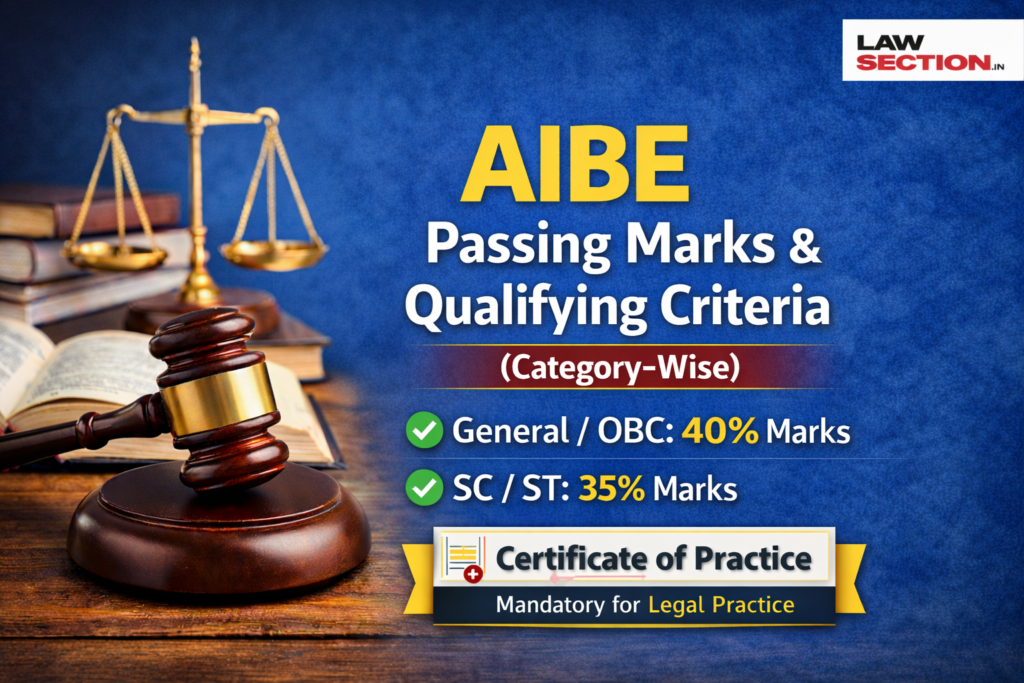
Preparing for the AIBE exam or planning to reappear? Explore our structured and updated guides covering AIBE exam eligibility, application process, important dates, results, and Certificate of Practice requirements.
All information is based on official notifications and updated for the latest AIBE exam cycle. Stay informed, avoid common mistakes, and prepare confidently for your legal career.

Recommended abroad opportunities for Law aspirants
Our editorial team curates these guides after reviewing official exam notifications, admission updates, and verified education sources to help law aspirants make informed decisions. Always cross-check final dates and rules from the official notification of the concerned year.
Study Law Abroad (LLB / LLM / PhD)
STUDY LAW ABROAD
Pursuing a PhD in Law Abroad: Full Guidance
Countries, eligibility, cost, intake timelines, and career outcomes explained clearly.
STUDY LAW ABROAD
LLM in UK / Canada / USA: Step-by-Step Guides
Compare top destinations for Indian students with admissions + visa guidance.
Career Abroad
Legal Internship Abroad
Students can choose internships based on their career goals, preferred practice area & international exposure.
