AIBE 2026 Passing Marks – Category-Wise Cut-Off, Minimum Marks & BCI Rules Explained
Reviewed by Rajni Bala, Assistant Professor of Law | Academic Review Panel
Last Updated: March 31, 2026
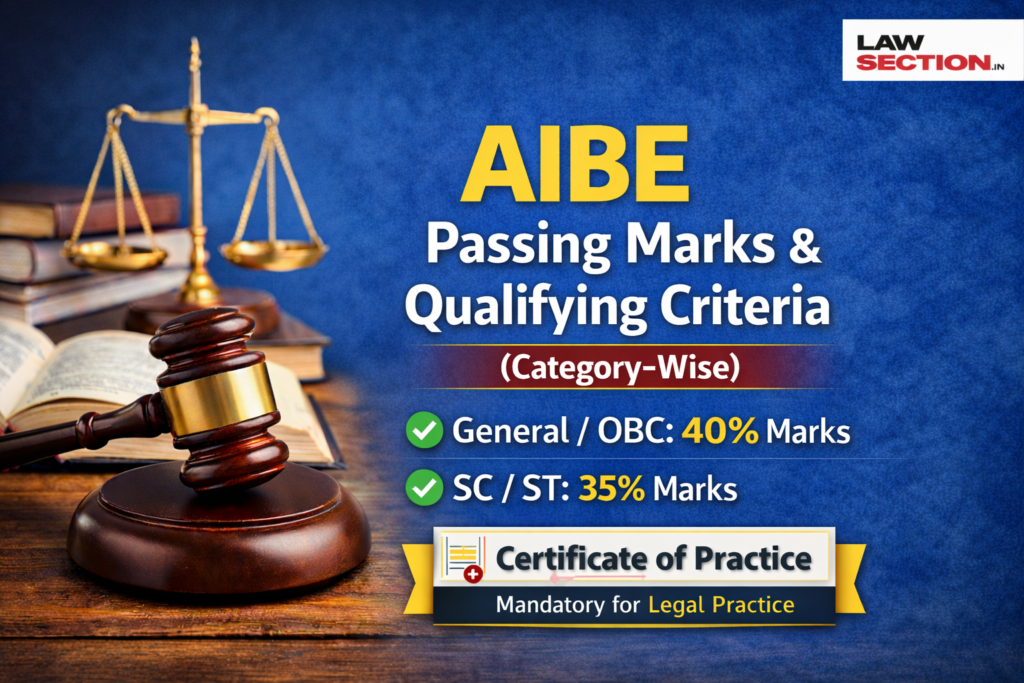
AIBE Passing Marks for 2026 are 45% (45 out of 100 marks) for General/OBC candidates and 40% (40 out of 100 marks) for SC/ST candidates. The All India Bar Examination (AIBE) is a qualifying exam conducted by the Bar Council of India (BCI), and there is no negative marking.
Candidates who secure the minimum qualifying marks are issued the Certificate of Practice (COP), which is mandatory to practise law in India under the Advocates Act, 1961.
Understanding the exact AIBE passing marks helps candidates focus on qualifying strategically rather than over-preparing for rank-based competition.
Start here: Complete AIBE Guide (Eligibility, Syllabus, Pattern & Strategy)
Quick Answer: AIBE Passing Marks 2026
AIBE Passing Marks 2026 are 45% (45 marks) for General/OBC and 40% (40 marks) for SC/ST candidates. The exam has 100 questions and no negative marking.
Explore more -> Eligibility Criteria | AIBE Syllabus | Exam Pattern | Result & Cut-off | Bare Acts for AIBE | Preparation Strategy
AIBE Passing Marks 2026 – Quick Overview
| Criteria | AIBE 2026 Details |
|---|---|
| Exam Name | All India Bar Examination (AIBE) XXI |
| Conducting Body | Bar Council of India (BCI) |
| Nature of Exam | Qualifying (Not Ranking-Based) |
| Total Questions | 100 MCQs |
| Total Marks | 100 |
| Negative Marking | No |
| Passing Marks – General/OBC | 45 marks (45%) |
| Passing Marks – SC/ST | 40 marks (40%) |
| Certificate Issued | Certificate of Practice (COP) |
| Purpose | Mandatory for practising law in India |
Category-Wise Minimum Marks Required to Qualify AIBE 2026
The Bar Council of India (BCI) prescribes different minimum qualifying marks for AIBE based on category. Since AIBE is a qualifying examination, candidates only need to secure the prescribed threshold — not a rank.
category-wise minimum marks required to pass AIBE 2026 are given below:
| Category | Minimum Marks (Out of 100) | Percentage Required | What It Means |
|---|---|---|---|
| General (GEN) | 45 marks | 45% | Eligible for Certificate of Practice (COP) after qualification |
| Other Backward Classes (OBC) | 45 marks | 45% | Eligible for Certificate of Practice (COP) after qualification |
| Scheduled Caste (SC) | 40 marks | 40% | Eligible for Certificate of Practice (COP) after qualification |
| Scheduled Tribe (ST) | 40 marks | 40% | Eligible for Certificate of Practice (COP) after qualification |
Legal Note (Updated March 2026):
AIBE is conducted by the Bar Council of India under the Advocates Act, 1961. The examination is qualifying in nature and does not provide ranks. Candidates who secure the prescribed minimum marks are issued the Certificate of Practice (COP), which is mandatory for practising law in India.
Detailed Explanation of AIBE Passing Criteria
Is There Negative Marking in AIBE?
No. As of March 2026, AIBE does not have negative marking. Candidates can attempt all 100 multiple-choice questions without penalty for incorrect answers. Since AIBE is a qualifying examination conducted by the Bar Council of India (BCI), the objective is to secure the minimum passing marks — not to compete for rank.
How Many Attempts Are Allowed in AIBE?
There is currently no fixed limit on the number of attempts for AIBE (as per the applicable framework in March 2026). Candidates may reappear until they qualify and obtain the Certificate of Practice (COP). However, candidates must remain enrolled with a State Bar Council to continue appearing for AIBE.
Does AIBE Rank Matter for Legal Practice?
No. AIBE does not provide ranks or merit lists. It is strictly a qualifying examination designed to assess minimum professional competence for law practice in India. Only the qualifying status matters for obtaining the Certificate of Practice from the Bar Council of India.
Is AIBE a Tough Exam to Pass?
AIBE is not a competitive ranking exam like CLAT or judicial services examinations. It is a qualifying test that assesses basic legal knowledge and understanding of core LL.B subjects. Since it is open-book in format and has no negative marking, focused preparation is generally sufficient to qualify.
Does Everyone Who Scores Passing Marks Receive the Certificate of Practice?
Yes. Candidates who secure the minimum qualifying marks prescribed by the Bar Council of India and whose results are verified by the respective State Bar Council become eligible to receive the Certificate of Practice (COP).
The COP allows advocates to legally practice law in Indian courts under the Advocates Act, 1961.
What Happens If You Score Below AIBE Passing Marks?
Candidates who score below the minimum qualifying marks in AIBE are considered to have failed the examination. However, they are allowed to reappear in the next AIBE exam conducted by the Bar Council of India.
Failing the AIBE does not cancel the LL.B. degree, but the candidate cannot practice law in Indian courts until the exam is cleared and the Certificate of Practice is issued.
What If You Fail AIBE?
- You can reappear in the next attempt
- Your LL.B. degree remains valid
- You cannot practice law until you pass AIBE
Common Mistakes & Misconceptions About AIBE Passing Marks
- Believing AIBE has a high cutoff like CLAT or judiciary exams
- Thinking rank matters (AIBE has no rank system)
- Ignoring Bare Acts despite open-book format
- Assuming multiple attempts affect future career
- Preparing advanced case laws instead of basics
Expert Tips to Clear AIBE in First Attempt
- Focus mainly on Bare Acts, not commentaries
- Prioritise core subjects: Constitutional Law, BNSS, CPC, BSA, BNS
- Practice previous year AIBE question papers
- Attempt all 100 questions (no negative marking)
- Revise legal maxims and professional ethics carefully
People Also Search For
- AIBE passing marks for General category
- AIBE qualifying marks 2026
- AIBE cut off marks category wise
- How many marks required to pass AIBE
- Is AIBE exam difficult
- AIBE Certificate of Practice rules
Important AIBE Exam Guides
If you are preparing for the All India Bar Examination, you should also read these detailed guides:
FAQs on AIBE Passing Marks (2026)
Q.1 – What are the passing marks in AIBE 2026?
General and OBC candidates must score 45 marks (45%) out of 100. SC/ST candidates must score 40 marks (40%) out of 100 to qualify AIBE 2026.
Q.2 – Is there negative marking in AIBE?
No. AIBE does not have negative marking, so candidates can attempt all questions without penalty.
Q.3 – How many attempts are allowed for AIBE?
There is no prescribed attempt limit. Candidates can reappear until they qualify.
Q.4 – Does AIBE provide ranks?
No. AIBE is only a qualifying examination. It does not provide ranks or merit lists.
Q.5 – What happens after passing AIBE?
After qualifying AIBE, candidates receive the Certificate of Practice (COP) from the Bar Council of India, which is mandatory for practising law in India.
Final Conclusion
AIBE passing marks are fixed and predictable, making the exam manageable with focused preparation. Since it is a qualifying and open-book exam, candidates should concentrate on Bare Acts and fundamentals rather than over-preparing
Clearing AIBE is the final step toward becoming a practicing advocate in India, so a smart and strategic preparation approach is all you need.
Related Posts for AIBE Aspirants
Our editorial team curates these guides after reviewing official exam notifications, admission updates, and verified education sources to help law aspirants make informed decisions. Always cross-check final dates and rules from the official notification of the concerned year.