AIBE Exam Pattern 2026 (XXII): Marks, Subjects, Passing Marks & Rules
Reviewed by Rajni Bala, Assistant Professor of Law | Academic Review Panel
Last Updated: August 20, 2026
The AIBE Exam Pattern 2026 (XXII) follows a 100-question, 100-mark multiple-choice format with a duration of 3 hours and 30 minutes. Scheduled for November 29, 2026, the All India Bar Examination XXII will use an offline, OMR-based answer sheet. Online registration opened on August 19, 2026, and the current examination framework provides for no negative marking. In addition, the latest BCI-notified AIBE syllabus framework available for reference covers 19 areas of law.
This guide explains the AIBE Exam Pattern 2026 (XXII) in a practical format, including the number of questions, total marks, duration, marking scheme, subject-wise distribution, qualifying marks, languages, open-book/Bare Act rules and what the pattern means for your preparation. Because examination instructions can be updated by the Bar Council of India (BCI), candidates should always follow the latest AIBE XXII notification and centre-specific instructions issued for their examination cycle.
Quick Answer: AIBE XXII is a 100-question, 100-mark, offline MCQ examination with a 3-hour-30-minute duration and no negative marking under the current framework. In addition, the latest BCI-notified AIBE syllabus framework available for reference covers 19 law subjects. Therefore, candidates should prepare the applicable statutory texts and follow the latest BCI examination instructions.
Explore More ->
AIBE XXII Exam Pattern 2026: At a Glance
| Particular | AIBE XXII 2026 |
|---|---|
| Examination | All India Bar Examination XXII |
| Conducting Body | Bar Council of India (BCI) |
| Exam Mode | Offline / Pen-and-paper / OMR |
| Question Type | Multiple-Choice Questions (MCQs) |
| Total Questions | 100 |
| Total Marks | 100 |
| Marks per Correct Answer | 1 mark |
| Negative Marking | No negative marking |
| Duration | 3 hours 30 minutes |
| Subjects | 19 law subjects |
| Qualifying Nature | Pass/Fail examination |
| AIBE XXII Registration | Started August 19, 2026 |
| Registration Deadline | October 27, 2026 |
| AIBE XXII Exam Date | November 29, 2026 |
According to the current 2026 schedule, the AIBE XXII examination is set for November 29, 2026. Meanwhile, online registration runs from August 19 to October 27, 2026, followed by the applicable fee-payment and correction deadlines. Candidates should therefore check the official AIBE portal for any subsequent schedule update.
How Many Questions Are Asked in AIBE XXII?
AIBE XXII consists of 100 objective-type questions, carrying a maximum of 100 marks. Each correct answer carries one mark.
Since there is no negative marking, the scoring structure is straightforward:
- Correct answer = +1 mark
- Incorrect answer = 0 marks
- Unattempted question = 0 marks
- Maximum score = 100 marks
As a result, candidates should avoid leaving questions unanswered merely because they are uncertain. However, strategic attempts still matter because the examination is time-bound, and candidates must record every answer correctly on the OMR sheet.
AIBE Exam Pattern 2026 (XXII): Subject-Wise Question Distribution
According to the latest BCI-notified AIBE syllabus framework available for reference, the examination covers 19 areas of law and 100 questions. Accordingly, the subject-wise distribution below reflects that notified framework. However, candidates should check the official AIBE XXII notification or syllabus if the Bar Council of India issues any cycle-specific revision.
| Subject | Questions |
|---|---|
| Constitutional Law | 10 |
| IPC / Bharatiya Nyaya Sanhita (BNS) | 8 |
| Criminal Procedure Code / Bharatiya Nagarik Suraksha Sanhita (BNSS) | 10 |
| Civil Procedure Code (CPC) | 10 |
| Evidence Act / Bharatiya Sakshya Adhiniyam (BSA) | 8 |
| Alternative Dispute Resolution | 4 |
| Family Law | 8 |
| Public Interest Litigation | 4 |
| Administrative Law | 3 |
| Professional Ethics & Cases of Professional Misconduct | 4 |
| Company Law | 2 |
| Environmental Law | 2 |
| Cyber Law | 2 |
| Labour & Industrial Law | 4 |
| Law of Tort, including Motor Vehicle and Consumer Protection Law | 5 |
| Law related to Taxation | 4 |
| Contract, Specific Relief, Property Laws & Negotiable Instruments | 8 |
| Land Acquisition Law | 2 |
| Intellectual Property Laws | 2 |
| Total | 100 |
In particular, candidates should study the criminal-law portion with attention to the Bharatiya Nyaya Sanhita (BNS), Bharatiya Nagarik Suraksha Sanhita (BNSS) and Bharatiya Sakshya Adhiniyam (BSA), alongside any legacy-law references that remain relevant to the applicable questions and transition context.
AIBE Exam Pattern 2026 (XXII): Exam Duration & Time Management
The total examination duration is 3 hours and 30 minutes for the standard paper.
On average, 100 questions over 3 hours and 30 minutes provide approximately 2.1 minutes per question. However, candidates do not need to spend exactly two minutes on every question. Some questions can be answered quickly, while others may require more time for provision-finding or careful interpretation.
In practice, candidates can use the following approach:
- Answer direct and familiar questions first.
- Mark difficult questions for review where the examination instructions permit.
- Avoid spending excessive time on a single question.
- Keep sufficient time for completing and checking the OMR sheet.
- Use the final portion of the examination for unanswered or doubtful questions.
Moreover, the open-book/Bare Act component makes familiarity with the structure and indexing of permitted material particularly important. However, candidates should not interpret this format as permission to carry unrestricted study material into the examination hall.
AIBE Exam Pattern 2026 (XXII): Open-Book & Bare Act Rules
Candidates should be careful with the phrase “open-book exam.” AIBE has specific rules governing what candidates may take into the examination hall. Therefore, the permission to carry Bare Acts does not mean candidates can freely bring textbooks, coaching material or unrestricted personal notes.
For AIBE XXII, candidates should rely on the latest BCI examination instructions regarding permitted Bare Acts and any permitted annotations. Unless those instructions expressly allow them, candidates should not assume that handwritten notes, extensive annotations, commentaries, textbooks or other study material are permitted.
Why Bare Act Familiarity Matters
Even with permitted Bare Acts, candidates can lose considerable time searching for provisions if they are unfamiliar with:
- The structure of major statutes
- Chapter and section organisation
- Definitions
- Important procedural provisions
- Frequently tested statutory concepts
- Cross-references between provisions
Ultimately, preparation should not be reduced to simply carrying books into the examination hall. The real advantage comes from knowing where relevant provisions are located and how to find them quickly.
AIBE XXII Qualifying Marks
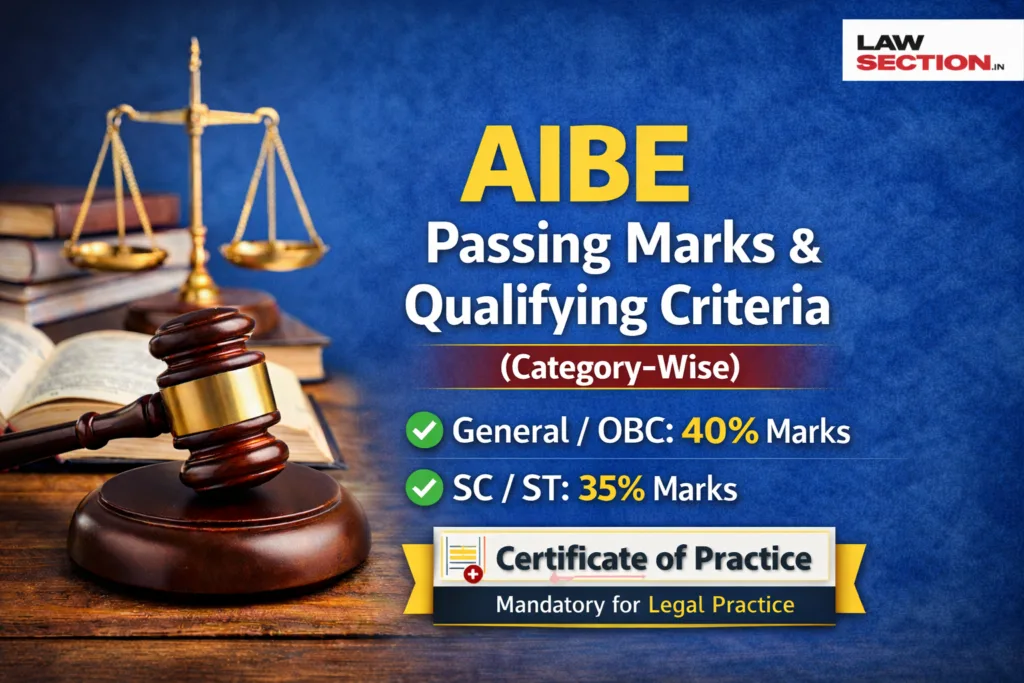
AIBE is a qualifying examination rather than a conventional rank-based entrance examination. Under the current qualifying framework, the minimum qualifying percentages are:
| Category | Minimum Qualifying Percentage | Equivalent Marks out of 100 |
|---|---|---|
| General / OBC | 45% | 45 |
| SC / ST | 40% | 40 |
| Specially Abled Candidates | 40% | 40 |
For this reason, candidates should treat these as the applicable qualifying thresholds under the current framework and verify the final AIBE XXII notification for any category-specific instruction or change before the examination.
Importantly, candidates should not automatically treat the minimum qualifying mark as their target score. Instead, they should build a reasonable margin above the minimum because their final result depends on their performance and the official evaluation process.
AIBE XXII Languages
The AIBE framework provides multiple language options, including English, Hindi, Punjabi, Bengali, Gujarati, Marathi, Tamil, Telugu, Kannada, Oriya and Assamese under the current language framework. Therefore, candidates should select the available language option during the application process and then verify the final admit card and examination instructions for the applicable paper language and centre-specific information.
What Does the AIBE XXII Pattern Mean for Your Preparation?
The exam pattern suggests three connected preparation priorities.
1. Build Coverage Across All 19 Subjects
First, do not prepare only the highest-weight subjects. Constitutional Law, Criminal Procedure, CPC and other higher-weight areas can significantly influence the score. At the same time, lower-weight subjects can provide relatively accessible marks, so candidates should maintain broad syllabus coverage.
2. Prioritise High-Weight Subjects
Next, give particular attention to the 10-question subjects because each represents a meaningful portion of the paper. Once these areas are reasonably covered, move systematically through the remaining subjects.
3. Practise Under Time Pressure
Finally, AIBE tests more than legal knowledge. Candidates must identify the correct answer and record it accurately within the available time.
Therefore, a strong preparation cycle should combine:
Concept revision → Bare Act familiarity → MCQ practice → Timed mock tests → Error analysis
AIBE XXII Exam-Day Rules: What Candidates Should Check
On exam day, candidates should follow the latest examination-day instructions issued by the Bar Council of India for AIBE XXII. For example, these instructions may specify permitted Bare Acts, prohibited electronic devices, reporting time, entry requirements, stationery and OMR-related procedures.
Before leaving for the examination centre, candidates should:
- Carry the AIBE XXII admit card.
- Carry the government-issued photo ID specified in the applicable examination instructions.
- Bring only materials expressly permitted under the latest BCI/AIBE guidelines.
- Follow the prescribed instructions for the OMR sheet and writing instrument.
- Check the reporting time and entry deadline printed on the current admit card or official examination instructions.
- Avoid relying on examination-hall rules published for an earlier AIBE cycle unless they are confirmed in the current XXII instructions.
Candidates should use the AIBE XXII admit card and latest official examination guidelines as the final authority for exam-day requirements.
Common AIBE XXII Preparation Mistakes to Avoid
In addition to understanding the pattern, candidates should avoid common mistakes that can reduce their score. These include:
- Assuming an open-book format means preparation is unnecessary.
- Preparing only high-weight subjects and ignoring the remaining syllabus.
- Ignoring the BNS, BNSS and BSA while revising criminal-law subjects.
- Spending too much examination time searching for provisions in permitted Bare Acts.
- Relying on outdated AIBE rules instead of checking the latest BCI instructions.
Overall, a focused preparation cycle should combine concept revision, Bare Act familiarity, MCQ practice, timed tests and error analysis.
Important AIBE Exam Guides
If you are preparing for the AIBE Exam 2026(XXII), you should also read these important guides:
- How to Pass AIBE in First Attempt (2026): Best Strategy, Books, Study Plan & Tips
- Can Final Year LLB Students Apply for AIBE?
- How to Prepare for AIBE 2026: 30-Day Study Plan to Crack AIBE in First Attempt
- AIBE Certificate of Practice (COP) Not Received – What To Do
- What Happens If You Fail AIBE? Career Impact Explained
- Can You Practice Law Without AIBE? BCI Rules Explained
Frequently Asked Questions About AIBE Exam Pattern 2026
1. How many questions are asked in AIBE XXII, and how many marks is the exam worth?
AIBE XXII consists of 100 MCQs carrying 100 marks. Each correct answer carries one mark.
2. Is there negative marking in AIBE XXII?
No. Under the current AIBE marking scheme, there is no negative marking for incorrect answers.
3. What are the passing marks for AIBE XXII?
The current qualifying threshold is 45% for General/OBC candidates and 40% for SC/ST and specially abled candidates.
4. Is AIBE XXII really an open-book exam?
AIBE permits candidates to use permitted Bare Acts according to the applicable BCI examination instructions. Candidates should not assume that textbooks, handwritten notes or other study material are automatically allowed.
5. Is AIBE XXII difficult to pass despite being an open-book exam?
Even so, the open-book format does not make preparation unnecessary. Candidates still need strong Bare Act familiarity, subject coverage, MCQ practice and effective time management to qualify.
Final Takeaway
The AIBE Exam Pattern 2026 (XXII) is straightforward in structure, but candidates should not mistake the open-book format for an examination that requires little preparation. Instead, they should understand the subject distribution, practise objective questions, become familiar with permitted Bare Acts and develop a time-efficient approach to the OMR-based paper.
In practice, the most effective approach combines broad syllabus coverage, current statutory knowledge, Bare Act familiarity, MCQ practice and disciplined time management. Because BCI may issue additional instructions, candidates should always verify the latest official notification, admit card and examination-day guidelines before appearing for the examination.
Finally, AIBE XXII registration is underway, and the examination is scheduled for November 29, 2026. Therefore, candidates should prepare from current BCI material rather than relying on outdated information from previous AIBE cycles.
Official References
- Bar Council of India (BCI): Official notifications and regulatory updates.
- All India Bar Examination: Official examination portal and candidate updates.
- AIBE XXII notification/schedule: For the current examination cycle, registration, deadlines and examination date.
- Advocates Act, 1961: Relevant statutory framework governing legal practice and enrolment.

Continue Learning (Previous Guide)
Choosing the Right Law College for LLM Abroad?
LLM abroad helps Indian law graduates gain international exposure, specialised legal knowledge, and global career opportunities.
Related Posts for AIBE Aspirants
Our editorial team curates these guides after reviewing official exam notifications, admission updates, and verified education sources to help law aspirants make informed decisions. Always cross-check final dates and rules from the official notification of the concerned year.