By Lawsection.in Editorial Team | March 16, 2026
Introduction
If you are planning a career in legal academia, research, or higher education, understanding the role of the University Grants Commission (UGC) is essential.
Whether you aim to qualify UGC NET for Law, pursue a PhD in Law, or join a university as an Assistant Professor, UGC regulations directly affect your eligibility and career path.
Explore more -> Eligibility Criteria | Syllabus & Pattern | Cut-off | Top NLUs | Preparation Strategy
This updated 2026 guide explains:
- What UGC is
- Its role in legal education
- UGC NET Law examination
- PhD in Law regulations
- Difference between UGC and BCI
- Career implications for law aspirants
What is UGC in Legal Education?
The University Grants Commission (UGC) is the statutory body responsible for regulating higher education in India under the UGC Act, 1956.
In legal education, the UGC sets academic standards for law degrees, regulates PhD programs in law, and conducts the UGC-NET examination for eligibility of Assistant Professors and JRF in law.
However, professional regulation of law degrees and enrollment of advocates is handled by the Bar Council of India (BCI).
Key Functions of UGC:
- Recognizes universities in India
- Frames regulations for higher education
- Conducts the UGC NET exam
- Sets eligibility criteria for Assistant Professors
- Regulates PhD standards
- Grants funding to universities
Quick Facts – Role of UGC in Legal Education
| Area | Role of UGC |
|---|---|
| Law Universities | Recognizes universities awarding law degrees |
| UGC NET Law | Conducts NET exam for Assistant Professor eligibility |
| PhD in Law | Regulates PhD admission and research standards |
| Research Grants | Funds legal research projects |
| Academic Standards | Maintains quality in higher education |
| Professional Practice | Controlled by BCI, not UGC |
Role of UGC in Legal Education
Legal education in India is regulated by two bodies:
- Bar Council of India (BCI) – Regulates professional law practice and LLB curriculum
- University Grants Commission (UGC) – Regulates higher education standards, faculty eligibility, research degrees
| Area | Regulator |
|---|---|
| LLB Curriculum | BCI |
| Advocate Enrollment | BCI |
| AIBE | BCI |
| Assistant Professor Eligibility | UGC |
| UGC NET | UGC |
| PhD in Law Standards | UGC |
If you want to become a law professor, UGC rules matter more than BCI rules.
What is UGC NET Law?
The UGC NET (National Eligibility Test) is conducted by the National Testing Agency (NTA) on behalf of UGC.
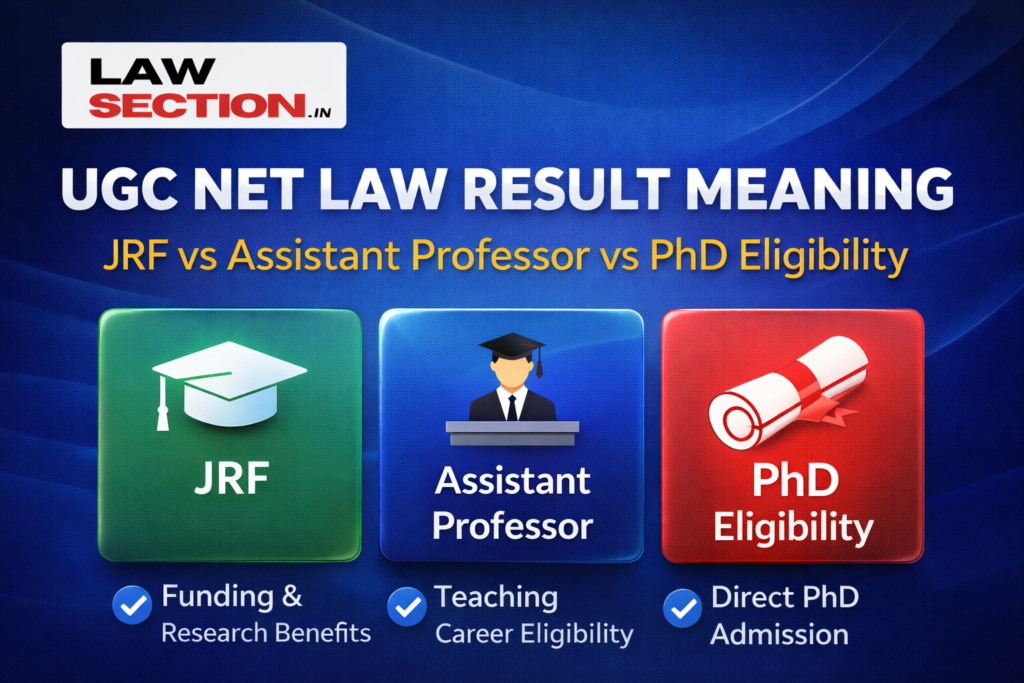
For law graduates, UGC NET Law (Subject Code 58) determines eligibility for:
- Assistant Professor in Law
- Junior Research Fellowship (JRF)
- PhD admissions (in many universities)
Who Can Apply?
Minimum Qualification:
- LLM with 55% marks (50% for reserved categories)
Final-year LLM students can also apply.
Is UGC NET Mandatory for Law Professors?
As per latest regulations (2026):
✔ UGC NET is mandatory for Assistant Professor posts
✔ NET is exempted if candidate has completed PhD under UGC 2009/2016/2022 Regulations
✔ Top NLUs may have additional criteria
Role of UGC in PhD in Law
UGC introduced strict PhD regulations to ensure quality research.
Key Highlights (Latest Regulations):
- Mandatory entrance test (unless NET/JRF qualified)
- Minimum coursework requirement
- Research publication standards
- Supervisor eligibility norms
- Plagiarism rules
Universities offering PhD in Law must comply with UGC guidelines.
Is UGC NET Law Difficult?
Many law students preparing for Assistant Professor careers also ask whether the UGC NET Law exam is difficult to crack.
The answer depends on factors like syllabus coverage, previous year paper analysis, and preparation strategy.
You can read the detailed analysis here: https://lawsection.in/is-ugc-net-law-difficult-real-difficulty-level-success-rate-explained/
UGC vs BCI – Important Difference for Law Students
Many students confuse UGC with BCI.
– UGC
- Regulates higher education
- Controls NET exam
- Sets PhD standards
- Determines faculty eligibility
– BCI
- Regulates law practice
- Approves LLB colleges
- Conducts AIBE
- Grants Certificate of Practice
If your goal is:
- Court practice → Focus on BCI + AIBE
- Teaching & Research → Focus on UGC + NET + PhD
Why UGC Matters for Law Aspirants
UGC impacts:
- Your eligibility to teach in universities
- Your research career
- PhD admissions
- Fellowship opportunities
- Academic promotions
Without UGC compliance, a university degree may not be valid for academic appointments.
Frequently Asked Questions (FAQs)
1. Is UGC applicable to NLUs?
Yes. NLUs are universities and must comply with UGC academic regulations, though professional law aspects are governed by BCI.
2. Can I teach law without NET?
Only if you hold a PhD under valid UGC regulations.
3. Is NET required for PhD in Law?
Not always, but NET/JRF often exempts you from entrance exams.
4. Who conducts UGC NET?
It is conducted by NTA on behalf of UGC.
5. Is UGC mandatory for law degrees in India?
Yes. A law degree must be awarded by a UGC-recognized university, but the Bar Council of India must also approve the law program for graduates to practice as advocates.
Internal Links
To improve user navigation and SEO authority, link this post internally to:
- CLAT Guide Page
- AIBE Exam Guide
- PhD in Law Admission Guide
- UGC NET Law Syllabus
- Assistant Professor Eligibility in India
Conclusion: Understanding the Role of UGC in Legal Education
The University Grants Commission (UGC) plays a crucial role in maintaining academic standards in legal education in India, particularly in areas such as UGC NET eligibility, PhD in Law regulations, and university accreditation.
However, professional legal practice is governed by the Bar Council of India (BCI), which regulates law colleges, curriculum, and advocate enrollment.
Therefore, students pursuing a legal career must understand the combined regulatory role of UGC and BCI to navigate law degrees, NET eligibility, and research opportunities effectively.