What is a Contract under Indian Law? (2026 Simple Guide with Real-Life Example)
Reviewed by Lawsection.in Editorial Team | May 21, 2026
What is a contract under Indian Law? It is one of the most fundamental concepts under the Indian Contract Act, 1872 and forms the basis of business transactions, employment agreements, online purchases, and legal obligations in India. Understanding what is a contract under Indian Law is essential for law students, Judiciary aspirants, AIBE candidates, CLAT PG preparation, and legal awareness readers.
If you buy a phone online, join a coaching institute, sign an employment offer, rent a flat, or hire a taxi through an app — you are entering into contracts every day.
Under Indian law, not every promise becomes a contract. A promise becomes legally enforceable only when it fulfills the requirements laid down under the Indian Contract Act, 1872 (ICA).
In this simple 2026 guide, you will learn the legal definition, essential elements, real-life examples, landmark cases, and exam-oriented notes on contract under Indian law.
Readers can also explore more foundational legal concepts through the “Law Notes” hub under the Indian Contract Act, 1872 cluster for systematic exam preparation and legal understanding.
What is a Contract under Indian Law?
A contract under Indian law means an agreement enforceable by law under Section 2(h) of the Indian Contract Act, 1872. A valid contract requires offer, acceptance, lawful consideration, free consent, competent parties, lawful object, certainty, and legal enforceability.
A contract under Indian law is an agreement enforceable by law under Section 2(h) of the Indian Contract Act, 1872. A contract becomes valid when an agreement fulfills legal essentials such as offer, acceptance, lawful consideration, free consent, competency of parties, lawful object, and intention to create legal obligations.
Formula
Agreement + Legal Enforceability = Contract
Legal Meaning of “Contract” under Indian Contract Act, 1872
The legal definition of contract is given under Section 2(h) of the Indian Contract Act, 1872, which states:
“An agreement enforceable by law is a contract.”
Official Government Source:
Section 2(h) – Indian Contract Act, 1872 (India Code)
This definition forms the foundation of Indian Contract Law.
To understand it easily:
Contract Formula
Contract = Agreement + Enforceability by Law
Therefore:
- Every contract is an agreement
- But every agreement is not a contract
This is one of the most important concepts for Judiciary exams, AIBE, CLAT PG, and UGC NET LAW.
Breaking Down Contract under Indian Law: Agreement + Enforceability
Step-by-Step Format
Step 1: What is an Agreement?
Under Section 2(e) of the Indian Contract Act, 1872:
“Every promise and every set of promises forming consideration for each other is an agreement.”
An agreement generally arises through:
Offer + Acceptance = Agreement
Example
Rahul offers to sell his laptop to Arjun for ₹40,000.
Arjun accepts the proposal.
An agreement is formed.
However, it becomes a contract only when law recognizes and enforces it.
Step 2: What is Enforceability by Law?
Legal enforceability means courts can legally recognize and enforce obligations between parties.
Example
A signs an employment agreement with company B.
Company B refuses salary despite completed work.
A may approach the court for legal remedy.
Therefore, this agreement becomes a contract.
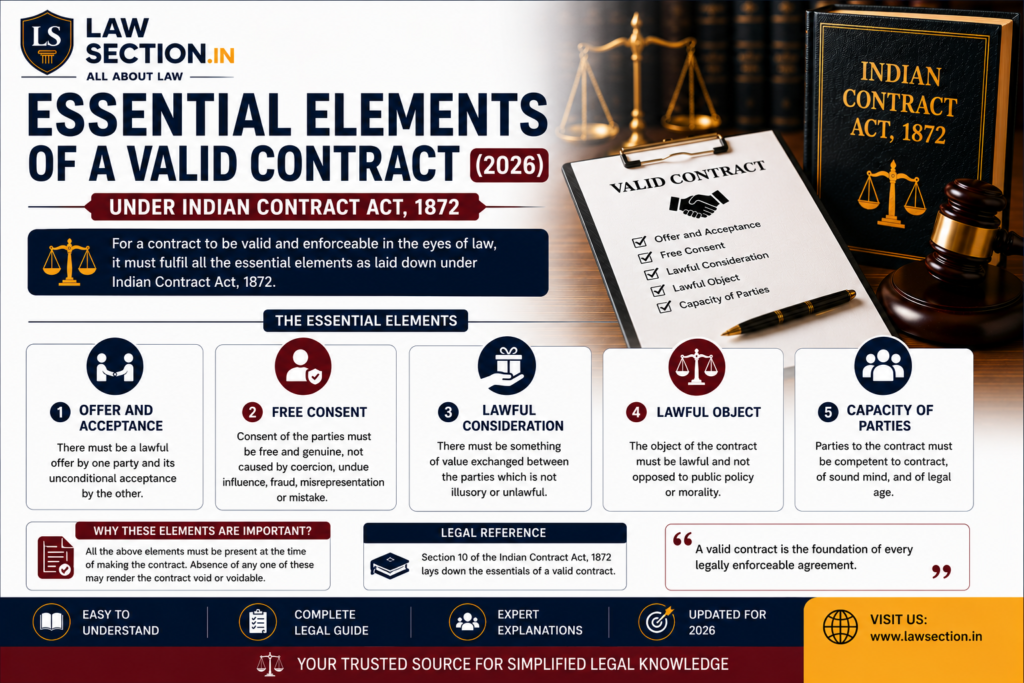
Essential Elements of a Valid Contract under Indian Law
For an agreement to become a valid contract, certain essentials must exist.
1. Offer and Acceptance
Contract begins with lawful offer and valid acceptance.
Example:
Seller offers bike for ₹80,000.
Buyer accepts.
Agreement formed.
Without offer and acceptance, contract cannot arise.
2. Intention to Create Legal Relationship
Parties must intend legal consequences.
Social or domestic arrangements generally lack such intention.
Example:
Family dinner promise = Not contract
Business sale agreement = Contract
3. Consideration in Contract under Indian Law
Consideration means something given in return.
Section 2(d) recognizes consideration.
Example
A sells a phone.
B pays money.
Phone ↔ Money
This exchange forms consideration.
Without consideration, agreements generally become void unless covered by legal exceptions.
4. Capacity of Parties in Contract under Indian Law
Under Section 11, parties must:
- Be major
- Be of sound mind
- Not be disqualified by law
Minor agreements are generally void.
Landmark Case
Mohori Bibee v. Dharmodas Ghose (1903)
The Privy Council held that a minor’s agreement is void ab initio.
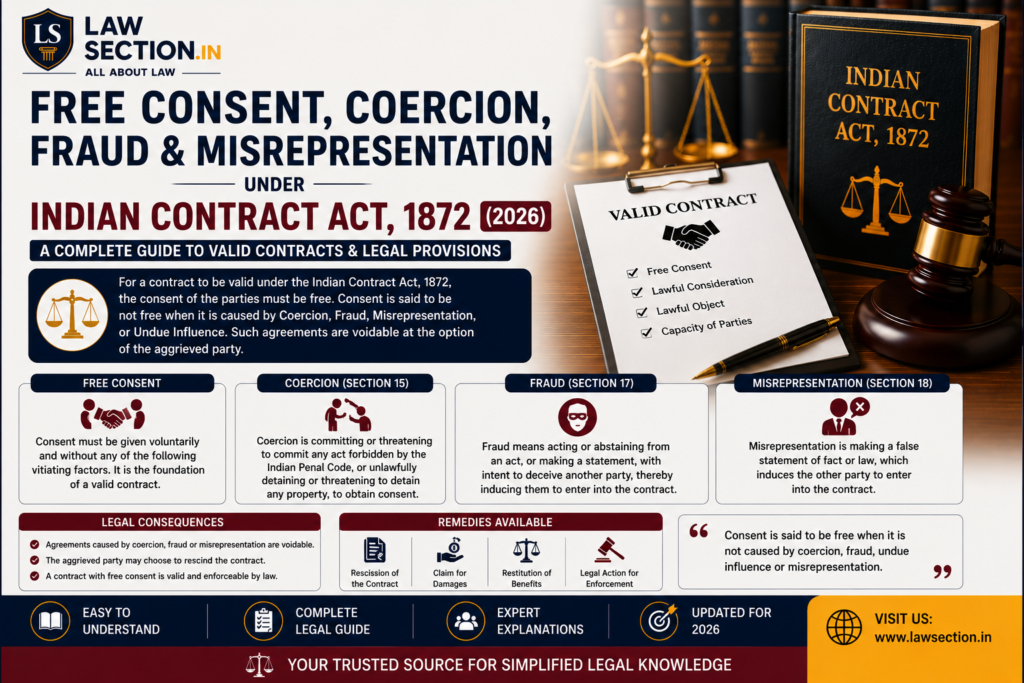
5. Free Consent in Contract under Indian Law
Consent must not be obtained through:
- Coercion
- Undue influence
- Fraud
- Misrepresentation
- Mistake
If consent is not free, the contract may become voidable.
6. Lawful Object in Contract under Indian Law
The object of agreement must be lawful.
Illegal objects destroy validity of contract.
Example
Agreement for illegal gambling operations.
Not enforceable.
7. Certainty and Possibility in Contract under Indian Law
Terms must be clear and capable of performance.
Example of Uncertainty
“I will pay reasonable amount someday.”
Uncertain agreement.
Void in law.
Example of Impossibility
Promise to bring extinct species back to life.
Impossible agreement.
Void agreement.
Diagram Formula for Exams
Offer + Acceptance + Consideration + Free Consent + Competent Parties + Lawful Object + Legal Enforceability = Valid Contract
This formula is highly useful for:
- Judiciary mains
- AIBE
- CLAT PG revision
- Viva preparation
Real-Life Example of Contract under Indian Law
Example 1: Valid Contract
Priya orders a laptop from an e-commerce platform for ₹60,000.
The website confirms the order.
Payment is completed.
Seller agrees delivery.
Elements Present
- Offer → Order placed
- Acceptance → Order confirmed
- Consideration → ₹60,000 payment
- Legal relationship → Present
Result:
A valid contract exists.
Example 2: Social Agreement (Not Contract)
Rahul tells his friend:
“I will take you for dinner tomorrow.”
Friend agrees.
Dinner never happens.
Can the friend sue Rahul?
No.
Reason:
There was no intention to create legal relationship.
Therefore, no valid contract exists.
Difference Between Agreement and Contract
| Basis | Agreement | Contract |
|---|---|---|
| Meaning | Promise between parties | Agreement enforceable by law |
| Legal enforceability | Not always | Always enforceable |
| Scope | Wider | Narrower |
| Remedy available | Not necessarily | Available |
| Example | Dinner promise | Sale agreement |
Important Judiciary & AIBE Exam Line
Every contract is an agreement, but every agreement is not a contract.
Common Mistakes Students Make in Contract Law
- Confusing agreement with contract
- Ignoring legal enforceability requirement
- Forgetting Section 2(h) definition
- Assuming every promise becomes contract
- Mixing void and voidable agreements
Types of Contracts under Indian Law
1. Valid Contract
Legally enforceable agreement fulfilling all essentials.
Example:
Employment contract.
2. Void Contract
Initially valid but later unenforceable.
Example:
Subsequent impossibility.
3. Void Agreement
Void from beginning.
Example:
Agreement with minor..
4. Voidable Contract
Enforceable at option of one party.
Example:
Contract induced by fraud.
5. Illegal Contract
Object itself unlawful.
Example:
Smuggling agreement.
6. Unenforceable Contract
Valid in substance but unenforceable due to technical defect.
Example:
Insufficient legal formalities.
Important Sections Related to Contract Definition (Exam Table)
| Section | Topic |
|---|---|
| Section 2(a) | Proposal |
| Section 2(b) | Acceptance |
| Section 2(d) | Consideration |
| Section 2(e) | Agreement |
| Section 2(h) | Contract |
| Section 10 | Essentials of valid contract |
| Section 11 | Competency |
| Sections 13–22 | Consent provisions |
Landmark Cases Every Law Student Must Know
1. Mohori Bibee v. Dharmodas Ghose (1903)
Principle:
Minor agreement is void ab initio.
2. Balfour v. Balfour (1919)
Principle:
Domestic arrangements generally lack legal intention.
3. Carlill v. Carbolic Smoke Ball Co. (1893)
Principle:
Offer, acceptance, and intention may create enforceable obligations.
Why Contract under Indian Law Matters in Daily Life
Contract law affects:
- Employment agreements
- Online shopping
- Banking
- Insurance
- Rental agreements
- Freelancing
- E-commerce
- Education services
- Business transactions
Almost every economic activity depends upon contracts.
Therefore, Contract Law is one of the most practical branches of law.
People Also Ask
Quick Revision Notes for Judiciary / AIBE / CLAT PG
Contract Definition
Agreement enforceable by law.
Section
Section 2(h)
Formula
Agreement + Legal Enforceability = Contract
Essentials
- Offer
- Acceptance
- Consideration
- Free Consent
- Competency
- Lawful Object
- Certainty
- Possibility
Most Important Case
Mohori Bibee v. Dharmodas Ghose
Golden Line
Every contract is an agreement, but every agreement is not a contract
Exam Memory Trick
“OAFCLL”
- O → Offer
- A → Acceptance
- F → Free Consent
- C → Consideration
- L → Lawful Object
- L → Legal Enforceability
Frequently Asked Questions (FAQs)
1. Why is contract law important in everyday life?
Contract law governs daily transactions such as online shopping, employment, rent agreements, banking, insurance, and business dealings.
2. What is the formula of a contract under Indian law?
The basic formula is:
Agreement + Legal Enforceability = Contract
This principle comes from Section 2(h) of the Indian Contract Act, 1872.
3. Can an oral agreement become a valid contract in India?
Yes. Oral agreements can become valid contracts if all essential elements of a contract are fulfilled and the law does not require written form.
4. What happens if a contract does not fulfill legal requirements?
If essential elements are missing, the agreement may become void, voidable, or unenforceable under the Indian Contract Act, 1872.
5. What is the most important section for understanding contract law in India?
Section 2(h) is the starting point because it legally defines a contract as “an agreement enforceable by law.”
Conclusion
The concept of contract under Indian law may appear simple because Section 2(h) uses only a few words, but it forms the backbone of the entire Indian Contract Act, 1872.
Every advanced topic — breach, damages, indemnity, guarantee, agency, quasi-contract, specific performance — begins here.
For law aspirants, mastering this topic first creates a strong base for the entire subject.
Continue learning through the “Law Notes” hub and related Indian Contract Act, 1872 topics for complete doctrinal understanding and exam-oriented preparation.