
Introduction
Reviewed by Rajni Bala, Assistant Professor of Law | Academic Review Panel
Last Updated: March 14,, 2026
The UGC NET Law Syllabus 2026 prescribed by the National Testing Agency (NTA) includes two papers: Paper 1 (Teaching & Research Aptitude) and Paper 2 (Law). Paper 2 covers Constitutional Law, Jurisprudence, BNS, BNSS, BSA, CPC, IPR, Environmental Law, Human Rights, and more. Both papers are objective with no negative marking.
Explore more -> Eligibility Criteria | Syllabus & Pattern | Cut-off | Top NLUs | Preparation Strategy
Why This Topic Matters for Law Students
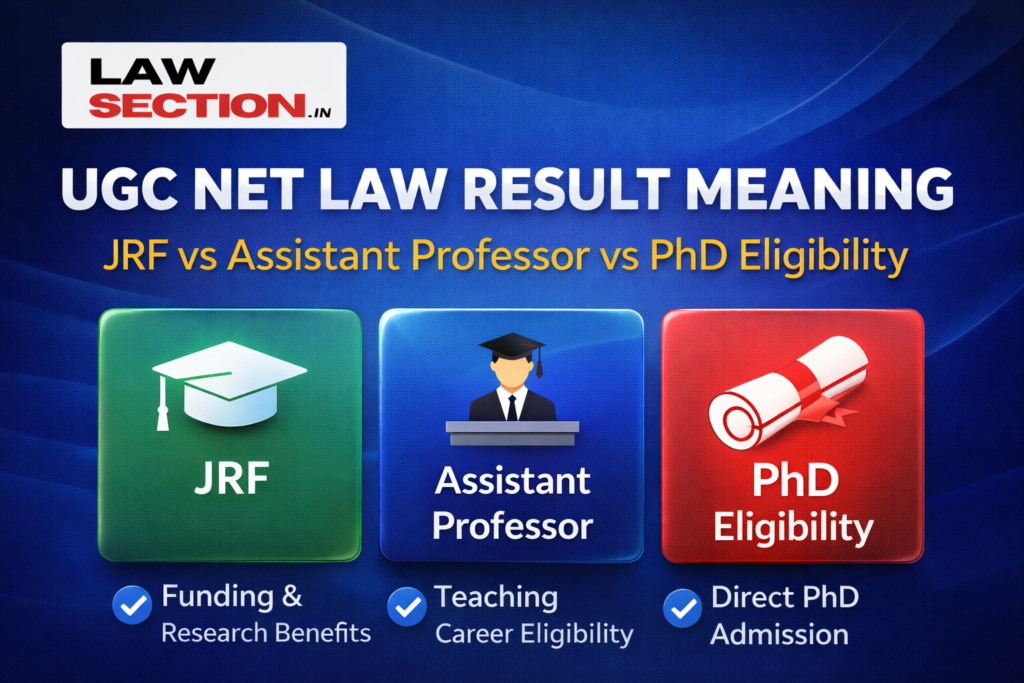
UGC NET Law is the gateway to becoming:
- Assistant Professor in Law Colleges/Universities
- Eligible for Ph.D. admissions
- Awarded Junior Research Fellowship (JRF)
Understanding the exact syllabus and paper pattern is the first step to cracking NET.
UGC NET Law Syllabus 2026 (Quick Overview)
UGC NET Law Syllabus 2026 consists of two papers conducted by the National Testing Agency (NTA):
| Point | Details |
|---|---|
| Exam | UGC NET Law 2026 |
| Conducted By | National Testing Agency |
| Papers | Paper 1 (General) + Paper 2 (Law) |
| Mode | Online (CBT) |
| Questions | 150 MCQs |
| Marks | 300 Marks |
| Negative Marking | No |
| Who Should Read | LL.M students, Law Graduates, Ph.D aspirants |
| What You’ll Learn | Subjects, topics, marking scheme, pattern |
Detailed Explanation
UGC NET Paper 1 Syllabus (Teaching & Research Aptitude)
UGC NET Paper 1 syllabus focuses on testing a candidate’s teaching ability, research aptitude, reasoning skills, and understanding of higher education systems. The syllabus prescribed by the National Testing Agency (NTA) is common for all subjects, including Law.
- Teaching Aptitude:Teaching methods, evaluation systems, learner characteristics, and classroom communication.
- Research Aptitude: Types of research, research ethics, research methodology, and thesis writing basics.
- Reading Comprehension: Passage-based questions to test analytical and interpretative ability.
- Communication: Types of communication, barriers, and effective communication in education.
- Mathematical Reasoning & Aptitude: Number series, percentages, ratios, and problem-solving ability.
- Logical Reasoning: Arguments, statements, conclusions, syllogisms, and reasoning patterns.
- Data Interpretation: Analysis of tables, graphs, charts, and numerical information.
- Information and Communication Technology (ICT): Basics of computers, internet, digital communication, and educational technology.
- People, Development and Environment: Environmental issues, sustainable development, and population dynamics.
- Higher Education System in India: Structure of higher education, policies, institutions, and regulatory bodies.
Paper 1 carries 100 marks (50 questions) and plays an important role in determining the UGC NET cutoff score.
UGC NET Law Syllabus 2026 (Paper 2 Subjects)
UGC NET Law Paper 2 tests candidates on core law subjects generally studied at the LLB and LLM level. The syllabus prescribed by NTA covers major branches of law including constitutional, criminal, corporate, and international law.
- Jurisprudence: Nature of law, schools of jurisprudence, legal concepts and theories.
- Constitutional and Administrative Law: Fundamental rights, directive principles, federal structure, judicial review, administrative powers.
- Public International Law and IHL: Sources of international law, treaties, state responsibility, humanitarian law.
- Law of Crimes: General principles of criminal law, offences, and defences.
- Law of Torts and Consumer Protection: Tort liability, negligence, strict liability, consumer protection framework.
- Family Law: Hindu law, Muslim law, marriage, divorce, guardianship, and succession.
- Law of Contracts and Mercantile Law: Indian Contract Act, sale of goods, partnership law, negotiable instruments.
- Corporate Law and Governance: Companies Act, corporate management, shareholder rights, corporate liability.
- Intellectual Property Rights (IPR): Copyright, patents, trademarks, and international IP agreements.
- Environmental Law: Environmental protection laws, sustainable development principles.
- Human Rights and International Organizations: International human rights law, United Nations system, protection mechanisms.
- Comparative Public Law and Governance: Comparative constitutional systems, global governance structures.
Paper 2 consists of 100 questions carrying 200 marks, covering major law subjects relevant for academic and research careers.
UGC NET Law Marking Scheme 2026
| Criteria | Marks |
|---|---|
| Correct Answer | +2 Marks |
| Wrong Answer | 0 |
| Unattempted | 0 |
No negative marking → Attempt all questions.
Common Mistakes UGC NET Law Aspirants Make
Many candidates fail to qualify UGC NET Law not because of difficulty but due to strategic mistakes in preparation.
Common mistakes include:
- Ignoring Paper 1 preparation
- Studying from Bare Acts only (NET needs concepts)
- Not solving previous year papers
- Underestimating IPR, Environmental Law, Human Rights
Many aspirants also question whether the exam is extremely difficult.
Read:- Is UGC NET Law Difficult?
How to Prepare for UGC NET Law 2026
To clear the UGC NET Law exam, aspirants should adopt a structured preparation strategy.
Step-by-step strategy
- Understand the complete UGC NET Law syllabus and exam pattern
- Study core subjects like Constitutional Law, Jurisprudence, and International Law thoroughly
- Solve previous year UGC NET Law question papers
- Practice mock tests regularly
- Revise key legal concepts and landmark judgments
Candidates should also regularly follow updates related to legal education regulators and professional bodies like the Bar Council of India (BCI) that influence the legal education system.
Read:- Role of BCI in Legal Education
What Happens After Qualifying UGC NET Law?
Clearing the UGC NET Law examination allows candidates to pursue several academic and professional opportunities.
Career opportunities after UGC NET Law
- Assistant Professor in Law Colleges and Universities
- Eligibility for Junior Research Fellowship (JRF)
- PhD admission in law universities
- Academic research career
- Legal policy and research roles
Many candidates preparing for UGC NET Law also explore the structure of legal education in India and the role of regulators like UGC and BCI.
Read -> UGC vs BCI – Who Controls Legal Education in India
People Also Ask (UGC NET Law)
Is there negative marking in UGC NET Law?
No. UGC NET Law exam does not have negative marking. Each correct answer carries 2 marks.
How many subjects are in UGC NET Law syllabus?
UGC NET Law syllabus includes major LLM-level subjects such as Constitutional Law, Jurisprudence, International Law, Corporate Law, Criminal Law, and Intellectual Property Law.
Is UGC NET Law syllabus based on LLB or LLM?
The syllabus is primarily based on LLM-level legal subjects, though many topics overlap with LLB curriculum.
Related Pages You Should Explore
If you are preparing for UGC NET Law 2026, these carefully curated guides on Lawsection will strengthen your overall preparation, exam awareness, and career clarity in the legal field. These pages are interlinked to help you understand how different law examinations, certifications, and study pathways connect with each other.
- Law Exams Hub – Complete guide to all major law entrance and eligibility exams in India.
- UGC NET Law Main Page – Eligibility, exam dates, application process, and preparation roadmap.
- AIBE Exam Guide – Understand how AIBE certification is mandatory after LL.B for law practice in India.
- Study Law Abroad – Explore LL.M and Ph.D. in Law options abroad after qualifying UGC NET/JRF.
These resources are structured to give law students a complete academic + professional roadmap from LL.B → NET/JRF → AIBE → Higher Studies / Teaching Career.
Frequently Asked Questions (FAQs)
Q1. How many papers are there in UGC NET Law?
Two papers — Paper 1 (General) and Paper 2 (Law).
Q2. Is there negative marking in UGC NET 2026?
No, there is no negative marking.
Q3. What are the important subjects in Paper 2 Law?
Constitutional Law, IPC, CPC, CrPC, IPR, Environmental Law, Jurisprudence.
Q4. Is Bare Act enough for UGC NET Law?
No, conceptual clarity and MCQ practice are essential.
Q5. Who conducts UGC NET Law exam?
The exam is conducted by the National Testing Agency.
Final Conclusion
The UGC NET Law Syllabus 2026 covers a wide range of core legal subjects along with teaching and research aptitude. Understanding the exam pattern, subject-wise syllabus, and marking scheme helps candidates prepare more strategically. Aspirants should focus on conceptual clarity, previous year questions, and consistent revision to perform well in the UGC NET Law examination conducted by the National Testing Agency.
Official References & Citations
- UGC NET Official Portal
- University Grants Commission NET Guidelines
- National Testing Agency Information Bulletin

Continue Learning (Previous Guide)
Choosing the Right Law College for LLM Abroad?
LLM abroad helps Indian law graduates gain international exposure, specialised legal knowledge, and global career opportunities.
Related posts UGC NET Law aspirants must explore
Our editorial team curates these guides after reviewing official exam notifications, admission updates, and verified education sources to help law aspirants make informed decisions. Always cross-check final dates and rules from the official notification of the concerned year.


This article is prepared by Lawsection.in Editorial Team after reviewing official notifications, exam authorities, and verified academic sources to ensure accuracy and usefulness for law aspirants.
