
Can You Practice Law Without AIBE? BCI Rules, Penalties & Reality (2026 Explained)
Reviewed by Rajni Bala, Assistant Professor of Law | Academic Review Panel
Last Updated: March 07,, 2026
If you are a law graduate planning to start practice, one important question naturally arises — Can you practice law without clearing AIBE?
The short answer is simple: No, you cannot independently practice law without clearing AIBE.
However, the complete answer involves the rules of the Bar Council of India (BCI), State Bar Councils, provisional enrollment, penalties, and the practical reality in 2026. Therefore, before making any decision, you must clearly understand how the system works.
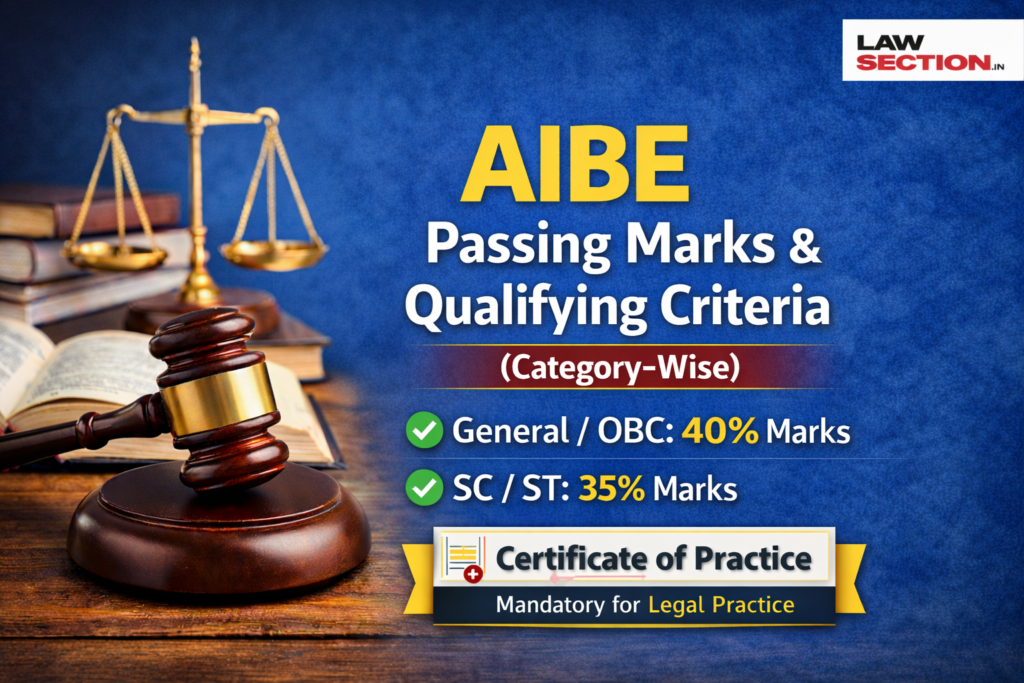
This article forms part of our comprehensive Law Exam section and the flagship AIBE Exam 2026 Complete Guide, covering eligibility, syllabus, registration, passing marks, and Certificate of Practice rules as per the latest BCI updates.
Explore more -> Eligibility Criteria | AIBE Syllabus | Exam Pattern | Result & Cut-off | Bare Acts for AIBE | Preparation Strategy
What Is AIBE and Why Is It Important?
The All India Bar Examination (AIBE) is conducted by the Bar Council of India.
It was introduced under Section 49(1)(ah) of the Advocates Act to ensure that every advocate meets minimum professional standards before practicing in Indian courts.
Once you clear AIBE, you receive:
- Certificate of Practice (COP)
- Full right to practice law in courts across India
On the other hand, without AIBE clearance, your practice rights remain restricted. Therefore, clearing AIBE is not just a formality — it is a mandatory professional requirement.
Step-by-Step: Can You Practice Without AIBE?
Let’s break this down clearly.
1. After LLB – Can You Directly Practice?
No, you cannot. After completing your LLB:
- You must enroll with your respective State Bar Council.
- Only after enrollment can you apply for AIBE.
Without enrollment, you cannot practice in any court. Therefore, enrollment is the first mandatory step.
– Read: What Is BCI? Role of BCI in LLB, Enrollment & Legal Education
2. After Enrollment – But Before Clearing AIBE?
This is where most confusion begins.
Once enrolled:
- You may receive provisional enrollment
- However, your right to practice is conditional
As per BCI rules:
- You must clear AIBE within the prescribed attempts/time.
- Otherwise, your Certificate of Practice can be suspended.
Therefore, although temporary practice may be allowed in certain situations, permanent and independent practice requires AIBE clearance.
What Does the Advocates Act & BCI Rules Say?
Under the Advocates Act, 1961:
- Only enrolled advocates can practice.
- However, BCI introduced AIBE as a mandatory qualifying exam.
- Certificate of Practice is linked with AIBE qualification.
In simple terms:
✔ Enrollment provides basic eligibility
✔ AIBE provides final validation of practice rights
Without clearing AIBE, your COP may not be confirmed. Consequently, your independent legal standing remains incomplete.
Can You Appear in Court Without AIBE?
Technically:
- If enrolled but not cleared AIBE → Limited or conditional practice
- If not enrolled → Absolutely not allowed
However, practically speaking:
- Courts require advocates to hold valid enrollment.
- Many procedural filings require Bar registration details.
- Lack of AIBE clearance can create professional and ethical issues.
Therefore, long-term court practice without AIBE is legally risky and professionally unsafe.
What Happens If You Don’t Clear AIBE?
Let us understand the real consequences in 2026 :
1. Suspension of Certificate of Practice
If you fail to clear AIBE within the required timeframe, the BCI may suspend your right to practice.
2. Professional Restrictions
In such cases, you may not be able to:
- Independently argue cases
- Sign vakalatnama freely
- Claim full advocate rights
3. Career Limitations
Additionally, you may face:
- Restrictions in law firms
- Problems in government job eligibility
- Complications in judicial service exams (depending on state rules)
Therefore, ignoring AIBE can seriously damage your legal career.
Practice Law Without AIBE: Common Myths vs Reality
Many law graduates misunderstand the rules. Therefore, let us clarify the most common myths.
| Myth | Reality |
|---|---|
| AIBE is optional | It is mandatory for full practice |
| Enrollment alone is enough | AIBE clearance required for COP |
| You can practice forever without AIBE | Risk of suspension |
| AIBE is just formal | It validates professional competence |
As you can see, the idea of practice law without AIBE is largely based on misinformation.
Who Is Exempted from AIBE?
Earlier, some senior advocates who enrolled before AIBE implementation received exemptions.
However, in 2026:
- New law graduates must clear AIBE.
- There is no general exemption for fresh enrollment.
Practical Reality in 2026
Let’s be honest.
Some junior advocates:
- Work under seniors
- Assist in drafting
- Appear occasionally
But legally speaking, without clearing AIBE, your independent right remains incomplete.
Therefore, if you are serious about litigation, clearing AIBE is non-negotiable.
What Should You Do Now? (Enrolment Help Section)
If you are confused, follow this structured roadmap:
Step-1 : Complete LLB from a BCI-approved college
Step-2 : Enroll with State Bar Council
Step-3 : Apply for AIBE
Step-4 : Clear AIBE
Step-5 : Obtain Certificate of Practice
If you need complete guidance, read:
- AIBE XXI Registration Guide
- How to Enroll in State Bar Council
- BCI vs UGC: Who Controls Legal Education?
Final Verdict: Can You Practice Without AIBE?
No, you cannot legally and independently practice law in India without clearing AIBE.
Enrollment alone is not sufficient. The Certificate of Practice is essential. Moreover, AIBE is mandatory to obtain that certificate.
Therefore, instead of delaying, prepare properly and clear AIBE as early as possible.
Related Posts: AIBE Exam Aspirants Must Explore
Preparing for the AIBE exam or planning to reappear? Explore our structured and updated guides covering AIBE exam eligibility, application process, important dates, results, and Certificate of Practice requirements.
All information is based on official notifications and updated for the latest AIBE exam cycle. Stay informed, avoid common mistakes, and prepare confidently for your legal career.

Study LLM Abroad: Top Law Universities in UK, USA & Canada
Planning to pursue an LLM abroad? Explore carefully curated and verified guides to top-ranked law universities in the United Kingdom, United States, and Canada. These country-wise pages provide structured information on admission requirements, eligibility criteria, tuition fees, intakes, scholarships, and career prospects — based on official university sources and updated as of 2026. Compare destinations confidently and choose the best pathway for your global legal career.
LLM In UK

Find the best Law Universities in United Kingdom.
LLM In USA

Explore Top-ranked Law Universities in the USA.
LLM in Canada

Canada’s Top-ranked Law Universities listed here.
