AIBE Exam Pattern 2026 (XXI) – Marks, Subjects, Passing Criteria
Reviewed by Rajni Bala, Assistant Professor of Law | Academic Review Panel
Last Updated: April 08, 2026
AIBE XXI registration begins February 11, 2026, and the examination is scheduled to be conducted on June 7, 2026, as officially announced by the Bar Council of India.
The Bar Council of India (BCI) conducts the All India Bar Examination (AIBE) to assess whether a law graduate is eligible to practice as an advocate in India. Understanding the latest AIBE Exam Pattern 2026 is crucial because the examination follows a unique open-book format. . Unlike most competitive exams, AIBE focuses more on practical application rather than rote memorisation. Therefore, knowing the exact structure in advance gives candidates a clear advantage.
This guide explains the exact paper structure, marking scheme, subjects, duration, qualifying marks, and open book rules as prescribed by BCI.
If you are appearing for AIBE after enrolment with your State Bar Council, this page gives you the complete blueprint of the paper.
Explore more -> Eligibility Criteria | AIBE Syllabus | Exam Pattern | Result & Cut-off | Bare Acts for AIBE | Preparation Strategy
Official Authority for AIBE Exam Pattern
The Bar Council of India officially prescribes and updates the AIBE exam pattern on the official portal. As per the latest notification, AIBE XXI registration starts from February 11, 2026, and the examination will be held on June 7, 2026.
Official Website: http://www.allindiabarexamination.com
AIBE Exam Pattern 2026 – At a Glance
| Particulars | Details |
|---|---|
| Exam Mode | Offline (OMR Based) |
| Nature of Exam | Open Book Examination |
| Type of Questions | Multiple Choice Questions (MCQs) |
| Total Questions | 100 Questions |
| Total Marks | 100 Marks |
| Exam Duration | 3 Hours 30 Minutes |
| Registration Start Date | February 11, 2026 |
| Exam Date | June 7, 2026 |
| Negative Marking | No Negative Marking |
| Language Options | 11 Regional Languages + English |
| Qualifying Nature | Pass/Fail (No Rank) |
What Does “Open Book Exam” Mean in AIBE?
AIBE is not a memory-based exam. BCI allows candidates to carry:
- Bare Acts (without handwritten notes)
- Printed study material
- Notes without written commentary
This tests your ability to find the correct law quickly rather than memorising sections. In other words, the exam evaluates your practical understanding of Bare Acts. Therefore, familiarity with indexing and structure becomes extremely important.
Important Note: Handwritten notes inside Bare Acts are not allowed.
Marking Scheme of AIBE 2026
| Criteria | Marks |
|---|---|
| Correct Answer | +1 Mark |
| Wrong Answer | 0 Mark |
| Unattempted | 0 Mark |
There is no negative marking, making smart attempt strategy important.
AIBE XXI Subject-Wise Marks Distribution
The AIBE question paper is based on core law subjects studied during LL.B. The Bar Council of India includes questions from constitutional law, criminal law, civil procedure, and professional ethics.
| Subject | Weightage (Approx.) |
|---|---|
| Constitutional Law | 10 |
| Indian Penal Code/Bharatiya Nyaya Sanhita (BNS) | 8 |
| Criminal Procedure Code/Bharatiya Nagarik Suraksha Sanhita (BNSS). | 10 |
| Civil Procedure Code | 10 |
| Evidence Act/Bharatiya Sakshya Adhiniyam (BSA) | 8 |
| Alternative Dispute Resolution | 4 |
| Family Law | 8 |
| Public Interest Litigation | 4 |
| Administrative Law | 3 |
| Professional Ethics & Cases | 4 |
| Company Law | 2 |
| Environmental Law | 2 |
| Cyber Law | 2 |
| Labour Law | 4 |
| Law of Tort | 5 |
| Miscellaneous | Remaining |
These subjects align with BCI’s prescribed LL.B curriculum.
Time Duration & Strategy
- Total Time: 3 Hours 30 Minutes
- 100 MCQs → Approx 2 minutes per question
Since the examination follows an open-book format, time management becomes critical. Although candidates can refer to Bare Acts, they must know exactly where each provision is located. Otherwise, valuable minutes may be lost.
Qualifying Marks in AIBE
| Category | Minimum Marks Required |
|---|---|
| General / OBC | 45 Marks out of 100 |
| SC / ST | 40 Marks out of 100 |
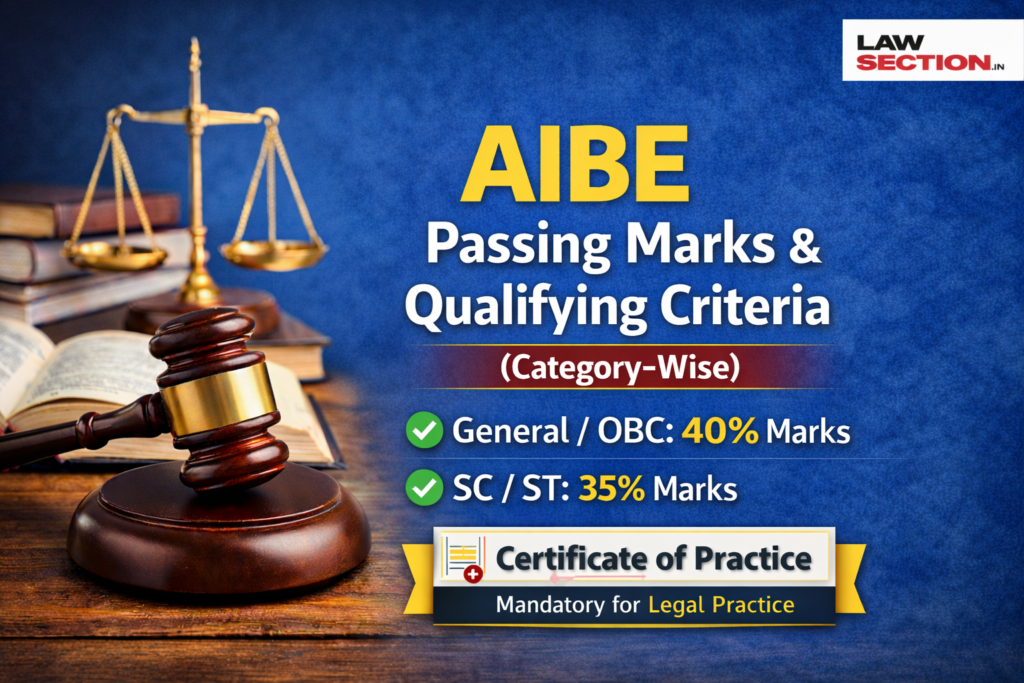
To qualify the AIBE exam, candidates must secure the minimum qualifying marks prescribed by the Bar Council of India. Currently, the passing marks are 45% for General and OBC candidates and 40% for SC and ST candidates.
Languages Available in AIBE
BCI conducts AIBE in multiple languages, including:
English, Hindi, Punjabi, Bengali, Gujarati, Marathi, Tamil, Telugu, Kannada, Oriya, Assamese.
OMR Based Offline Examination
BCI conducts the examination in pen-paper mode using an OMR sheet. Candidates must carefully fill bubbles using a black/blue ball pen.
Is There Negative Marking in AIBE Exam?
No, there is no negative marking in the AIBE examination. Candidates receive one mark for each correct answer and no marks are deducted for incorrect responses.
Is AIBE an Open Book Examination?
Yes, the AIBE exam is an open-book examination. Candidates are allowed to carry bare acts without notes or comments into the examination hall. However, printed study materials and handwritten notes are not permitted.
AIBE 2026 Exam Day Rules You Must Follow (Avoid Disqualification)
- Electronic devices such as mobile phones, smartwatches, calculators, or Bluetooth gadgets are strictly prohibited inside the exam hall and may lead to disqualification.
- Only printed Bare Acts without notes or commentary are allowed; any additional material or guides will not be permitted.
- Handwritten notes, highlighted pages, sticky slips, or any annotations inside Bare Acts are strictly forbidden and treated as unfair means.
- Candidates must reach the exam centre at least 1 hour before reporting time, as late entry is usually not allowed after gate closing.
- Carry your printed admit card, advocate enrolment certificate, and a valid photo ID proof, otherwise entry to the exam hall may be denied.
Why Understanding Exam Pattern is Crucial for AIBE Success?
Unlike other competitive examinations, AIBE primarily checks practical readiness for legal practice. Specifically, it evaluates:
- Practical application of law
- Ability to locate provisions quickly
- Understanding of Bare Acts
- Basic professional legal knowledge
Therefore, candidates must focus on clarity of concepts rather than excessive theory reading. If you understand the pattern, AIBE becomes one of the easiest law examinations to clear.
People Also Search For
- AIBE XXI syllabus 2026
- AIBE passing marks 2026
- Is AIBE exam difficult
- AIBE exam pattern and syllabus
- Bare Acts allowed in AIBE exam
- How many attempts are allowed in AIBE
Important AIBE Exam Guides
If you are preparing for the AIBE Exam 2026(XXI), you should also read these important guides:
- Can Final Year LLB Students Apply for AIBE?
- AIBE Certificate of Practice (COP) Not Received – What To Do
- What Happens If You Fail AIBE? Career Impact Explained
- Can You Practice Law Without AIBE? BCI Rules Explained
- Complete guide to all major law entrance and eligibility exams in India.
- Understand how AIBE certification is mandatory after LL.B for law practice in India.
Frequently Asked Questions (AIBE Exam Pattern 2026)
Q1. How many questions are asked in the AIBE exam?
The AIBE examination contains 100 multiple-choice questions from core law subjects studied during LL.B. The paper is conducted in an offline OMR-based format.
Q2. Is there negative marking in AIBE?
No. The Bar Council of India has confirmed that there is no negative marking in AIBE. Candidates receive +1 mark for each correct answer and 0 marks for wrong or unattempted questions.
Q3. What are the passing marks in AIBE 2026?
To qualify the AIBE examination:
• General / OBC candidates must score 45 marks out of 100
• SC / ST candidates must score 40 marks out of 100
Candidates who meet the minimum qualifying marks receive the Certificate of Practice (CoP) from the Bar Council of India.
Q4. Can candidates carry Bare Acts in the AIBE exam?
Yes. AIBE is an open-book examination, and candidates are allowed to carry printed Bare Acts without handwritten notes. Any Bare Act containing handwritten comments or markings may not be permitted.
Q5. In how many languages is AIBE conducted?
The AIBE examination is conducted in multiple languages including English, Hindi, Punjabi, Bengali, Gujarati, Marathi, Tamil, Telugu, Kannada, Oriya, and Assamese.
Q6. What is the duration of the AIBE exam?
The total duration of the AIBE examination is 3 hours and 30 minutes, during which candidates must complete all 100 MCQs.
Q7. Is AIBE compulsory to practice law in India?
Yes. According to the Bar Council of India, law graduates who enroll with a State Bar Council must pass the All India Bar Examination (AIBE) to obtain the Certificate of Practice and practice as an advocate in India.
Final Conclusion
The AIBE Exam Pattern 2026, with registration beginning on February 11 and the examination scheduled for June 7, 2026, is designed to ensure that every enrolled advocate possesses minimum practical legal knowledge before starting practice. With an open-book format, no negative marking, and straightforward MCQs, success depends more on Bare Act familiarity and time management than rote learning.
Always follow updates published by the Bar Council of India on the official AIBE portal.
Official References & Citations
- Bar Council of India – AIBE Guidelines
http://www.allindiabarexamination.com - Advocates Act, 1961 – Certificate of Practice requirement

Continue Learning (Previous Guide)
Choosing the Right Law College for LLM Abroad?
LLM abroad helps Indian law graduates gain international exposure, specialised legal knowledge, and global career opportunities.
Related Posts for AIBE Aspirants
Our editorial team curates these guides after reviewing official exam notifications, admission updates, and verified education sources to help law aspirants make informed decisions. Always cross-check final dates and rules from the official notification of the concerned year.