
National Law University Delhi (NLU Delhi)
Description
About National Law University Delhi (NLU Delhi)
Verified by Lawsection.in Editorial Team | Updated: June 08, 2026
National Law University Delhi (NLU Delhi) is one of India’s leading institutions for legal education, research, and public policy studies. Established in 2008 under the National Law University Delhi Act, 2007, the university has developed a strong reputation for academic excellence, interdisciplinary learning, and research-driven legal scholarship.
Located in Sector 14, Dwarka, New Delhi, NLU Delhi offers undergraduate, postgraduate, doctoral, and other academic programmes in law. Unlike most National Law Universities that participate in the Common Law Admission Test (CLAT), NLU Delhi conducts its own entrance examination, the All India Law Entrance Test (AILET), for admission to its flagship law programmes.
Over the years, the university has emerged as a prominent centre for legal education by combining rigorous academics with research, policy engagement, and practical legal learning. Furthermore, its location in the national capital provides students with valuable exposure to courts, regulatory bodies, government institutions, policy organisations, legal practitioners, and research centres.
In addition, NLU Delhi has consistently secured a place among India’s top law institutions. In the NIRF Law Rankings 2025 released by the Ministry of Education, Government of India, the university was ranked 2nd among law institutions in India, reflecting its performance in teaching, research, graduate outcomes, outreach, and institutional perception.
As a result, NLU Delhi continues to attract highly motivated students, researchers, and legal scholars from across the country who seek quality legal education and professional development opportunities.
University Snapshot
Location
New Delhi, India
Campus
Sector 14, Dwarka, New Delhi
Established
2008
Type
National Law University
Admission Test
AILET (All India Law Entrance Test)
Recognition
Recognised by the University Grants Commission (UGC) and established under the National Law University Delhi Act, 2007
Major Programmes
BA LL.B. (Hons.), LL.M., Ph.D., and other academic programmes notified by the university
NIRF Law Ranking 2025
Ranked 2nd among law institutions in India
Main Intake
Generally aligned with the university’s academic calendar
Important: Admission schedules, eligibility requirements, reservation policies, seat intake, fee structures, counselling procedures, and academic regulations may change from time to time. Applicants should always verify the latest information through official university notifications before applying.
The university may revise admission criteria, reservation policies, programme structures, examination requirements, fee schedules, and other academic regulations from time to time. Applicants should refer to the latest official notifications and university website before making admission-related decisions.
Law Programmes Offered by NLU Delhi
National Law University Delhi offers legal education at undergraduate, postgraduate, and doctoral levels. The university focuses on developing analytical ability, legal reasoning, research skills, professional ethics, and interdisciplinary understanding through its academic programmes.
BA LL.B. (Hons.)
Duration: 5 Years (Integrated)
Eligibility: As prescribed in the latest AILET admission notification issued by the university
Admission Process: Admission is conducted through AILET and the subsequent counselling process
Programme Overview: The BA LL.B. (Hons.) programme combines legal education with social sciences and interdisciplinary learning. The curriculum is designed to provide comprehensive legal training through classroom teaching, research activities, moot court participation, legal aid initiatives, internships, and clinical legal education.
Students are introduced to core areas of law while simultaneously developing research, advocacy, writing, and analytical skills that support diverse legal career pathways.
LL.M. Programme
Duration: 1 Year
Eligibility: LL.B. degree or equivalent qualification as prescribed in the latest admission notification
Admission Process: Admission is based on performance in AILET (LL.M.) and the counselling process conducted by the university
Programme Overview: The LL.M. programme provides advanced legal education and specialised academic training. It encourages critical analysis, independent research, and scholarly engagement with contemporary legal issues.
Furthermore, the programme is particularly suitable for students interested in legal research, higher studies, academia, policy development, and specialised areas of legal practice.
Ph.D. in Law
Duration: As prescribed under the university’s doctoral regulations
Eligibility: As specified in the latest Ph.D. admission notification issued by NLU Delhi
Admission Process: Admission is conducted through the selection process notified by the university
Programme Overview: The doctoral programme is designed for advanced legal research and original scholarly contribution. Ph.D. scholars undertake in-depth research under faculty supervision and contribute to academic discourse, legal scholarship, and policy development
Why Choose NLU Delhi?
National Law University Delhi occupies a distinctive position within India’s legal education ecosystem. Unlike most National Law Universities that admit students through CLAT, NLU Delhi follows an independent admission process through AILET. Consequently, admission to the university remains highly competitive and attracts applicants from across the country.
Moreover, the university emphasises:
- Research-led legal education
- Interdisciplinary academic learning
- Public policy engagement
- Legal scholarship and innovation
- Clinical legal education
- Constitutional values and rule of law
- Academic excellence and professional development
In addition, NLU Delhi actively encourages students to participate in moot courts, research projects, conferences, seminars, legal aid initiatives, publications, and policy discussions.
Because the university is located in New Delhi, students also benefit from proximity to the Supreme Court of India, Delhi High Court, government institutions, regulatory bodies, policy think tanks, and leading legal professionals. As a result, they gain exposure to the broader legal and policy ecosystem while pursuing their studies.
Recognition and Institutional Status
National Law University Delhi enjoys significant academic recognition within India’s higher education framework and is widely regarded as one of the country’s leading centres for legal education and research.
Key institutional features include:
- Established under the National Law University Delhi Act, 2007.
- Functions as a specialised law university dedicated to legal education, legal research, and public policy studies.
- Recognised by the University Grants Commission (UGC).
- Operates within the applicable regulatory framework governing higher education and legal studies in India.
- Consistently ranks among India’s leading law institutions in national rankings.
- Maintains a strong reputation for academic excellence, research output, and institutional credibility.
Consequently, NLU Delhi continues to be recognised as one of India’s most respected destinations for legal education, advanced legal research, and policy-oriented scholarship.
Faculty, Research and Academic Environment
One of NLU Delhi’s most significant strengths is its commitment to research, academic scholarship, and intellectual engagement. The university actively promotes a research-oriented learning environment through academic centres, faculty-led projects, publications, conferences, seminars, workshops, and interdisciplinary initiatives.
Furthermore, faculty members engage in teaching and research across a broad range of legal and interdisciplinary fields, including:
- Constitutional Law
- Criminal Justice
- Corporate and Commercial Law
- International Law
- Public Policy
- Human Rights Law
- Technology and Law
- Environmental Law
- Other interdisciplinary areas of legal scholarship
The university also encourages students to participate in research activities, academic writing, legal publications, policy discussions, and scholarly projects throughout their academic journey.
As a result, students benefit from an academic environment that combines doctrinal legal education with practical learning, critical thinking, policy analysis, and research-based problem solving.
Why Students Choose NLU Delhi
National Law University Delhi attracts students from across India because of its strong academic reputation, competitive admission process, research-oriented environment, and national standing in legal education.
The university is particularly suitable for:
- Students seeking admission to one of India’s highest-ranked law institutions.
- Candidates interested in corporate law, litigation, public policy, legal research, and regulatory practice.
- Aspirants planning careers in academia, higher legal studies, or public service.
- Students looking for interdisciplinary legal education combined with research opportunities.
- Individuals seeking exposure to courts, government institutions, policy organisations, and the broader legal ecosystem of the national capital.
Furthermore, the university’s emphasis on academic excellence, legal scholarship, and professional development continues to attract highly motivated law aspirants every year.
Campus and Student Life
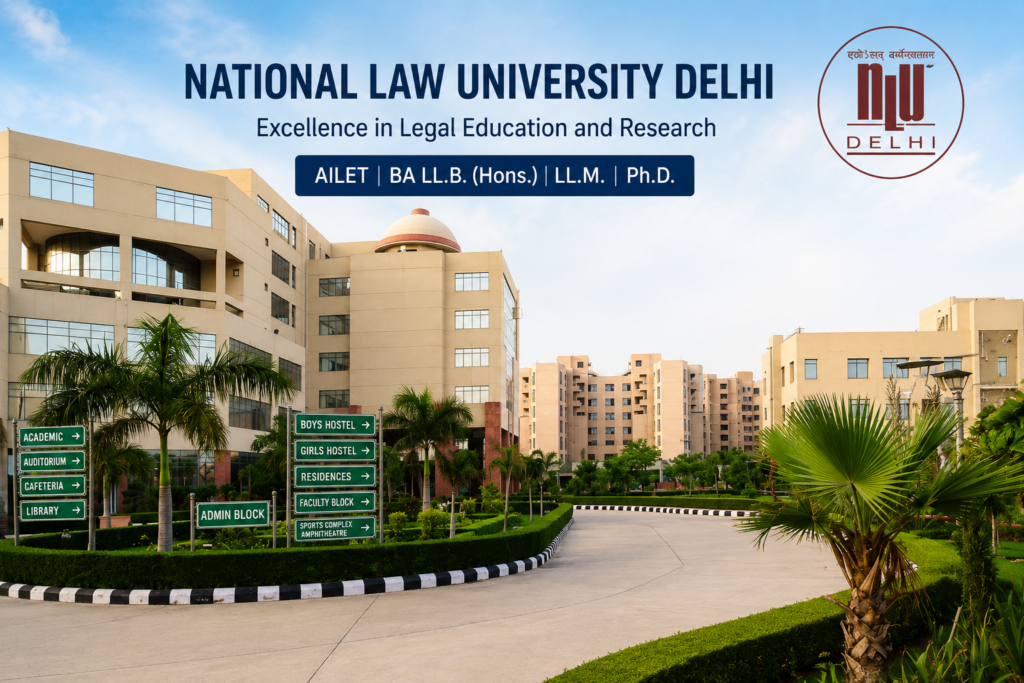
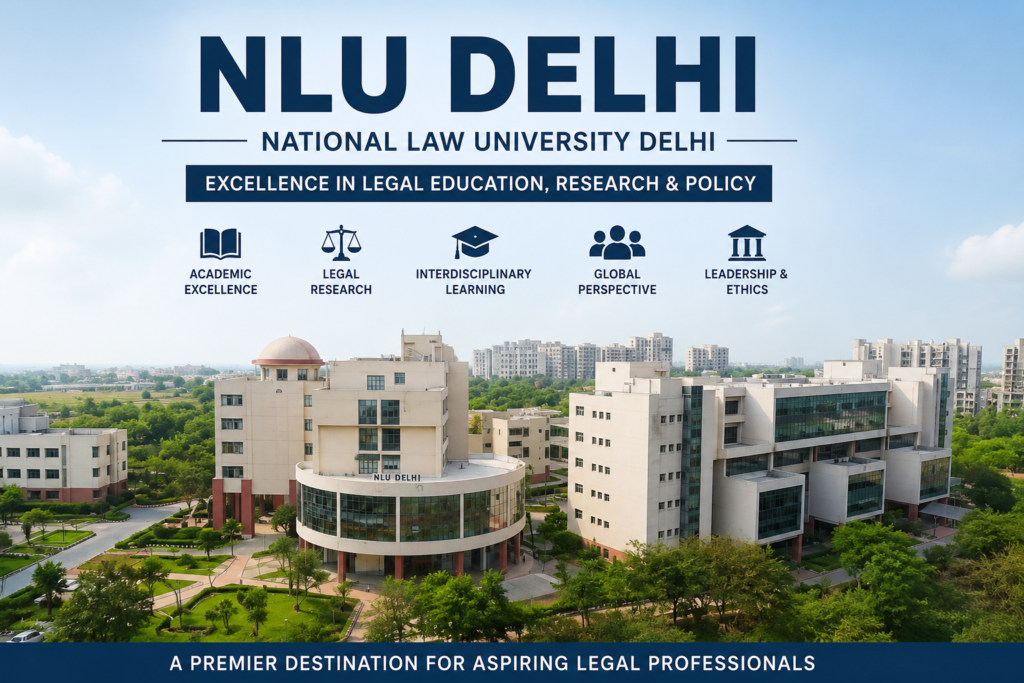
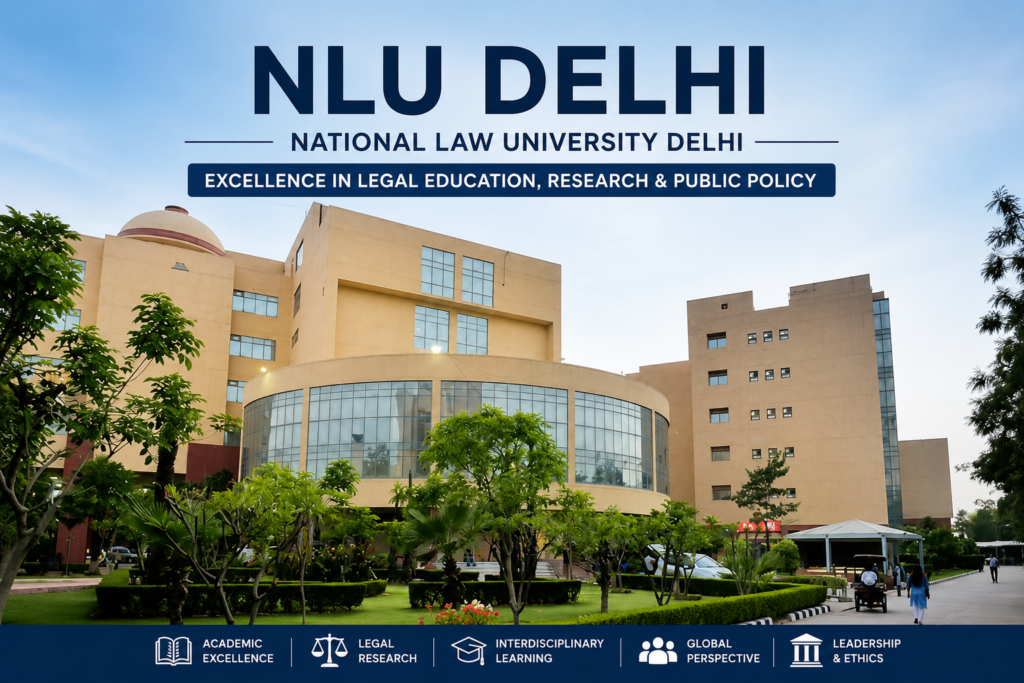
NLU Delhi provides a modern academic environment designed to support both educational and professional development. The campus includes academic facilities, library resources, student support services, residential accommodation, research centres, and spaces for co-curricular engagement.
In addition, students regularly participate in moot court competitions, academic conferences, cultural activities, legal aid initiatives, student-led organisations, and research programmes. These opportunities help students develop advocacy skills, leadership abilities, teamwork, and professional confidence.
Consequently, campus life at NLU Delhi extends beyond classroom learning and contributes to the holistic development of future legal professionals.
Research Centres and Academic Initiatives
National Law University Delhi actively promotes legal research, public policy engagement, and interdisciplinary scholarship through its academic and research centres. These centres contribute to legal education by organising conferences, seminars, workshops, lectures, training programmes, and research projects on contemporary legal and policy issues.
Furthermore, students often receive opportunities to engage in research activities, academic discussions, publications, and policy-oriented initiatives under the guidance of faculty members and subject experts. As a result, the university fosters a vibrant academic environment that supports both intellectual growth and professional development.
Rankings and Reputation
National Law University Delhi consistently performs strongly in national law school rankings and enjoys a respected reputation within legal academia, the judiciary, policy institutions, and the legal profession.
According to the National Institutional Ranking Framework (NIRF) 2025, released by the Ministry of Education, Government of India, NLU Delhi secured Rank 2 among law institutions in India.
This achievement reflects the university’s performance across multiple parameters, including:
- Teaching, Learning and Resources
- Research and Professional Practice
- Graduation Outcomes
- Outreach and Inclusivity
- Institutional Perception
In addition, NLU Delhi is widely recognised for its research culture, academic standards, and contribution to legal scholarship.
As a result, it continues to be regarded as one of India’s premier institutions for legal education and advanced legal studies.
AILET: The Entrance Examination for NLU Delhi
The All India Law Entrance Test (AILET) is the primary entrance examination conducted by National Law University Delhi for admission to its major law programmes.
Unlike most National Law Universities that participate in CLAT-based admissions, NLU Delhi conducts AILET independently. Consequently, candidates seeking admission to the university’s flagship programmes must appear for AILET and meet the eligibility requirements prescribed in the official admission notification.
What Makes AILET Unique?
Several factors distinguish AILET from other law entrance examinations:
- It is conducted exclusively for admission to NLU Delhi.
- It follows an independent admission process.
- Competition remains extremely high because of limited seats and strong national demand.
- The examination assesses aptitude, analytical ability, reasoning skills, language proficiency, and legal awareness as prescribed in the official syllabus.
Because admission opportunities are limited, candidates generally require focused preparation and a strong performance to secure a competitive rank.
Is AILET Difficult?
AILET is generally regarded as a highly competitive law entrance examination because admission to NLU Delhi is based on a limited number of seats and a national-level applicant pool.
The examination attracts thousands of applicants every year, while the number of available seats remains limited. Consequently, candidates often face intense competition during the admission process.
However, success in AILET depends on multiple factors, including:
- Preparation strategy
- Understanding of the examination pattern
- Reading and analytical ability
- Time management skills
- Consistent practice and revision
Therefore, students planning to appear for AILET should begin their preparation well in advance and regularly follow official notifications issued by the university.
Documents Required for Admission
Applicants participating in the admission and counselling process should generally keep the following documents ready for verification purposes:
- AILET Admit Card
- AILET Scorecard or Result
- Class 10 Certificate or Marksheet
- Class 12 Certificate or Marksheet (for undergraduate admissions)
- LL.B. Degree and Academic Records (for LL.M. admissions)
- Government-issued Identity Proof
- Passport-size Photographs
- Category Certificate, if applicable
- PwD Certificate, if applicable
- Migration Certificate, if required
- Any additional documents specified in the official admission notification
Applicants should always refer to the latest admission instructions issued by the university for the most current documentation requirements.
Is Document Verification Mandatory?
Yes. Document verification is an essential part of the admission process.
Candidates must produce the required documents in the format prescribed by the university. Admission is generally confirmed only after successful verification of documents and completion of all admission-related formalities.
Therefore, applicants should carefully review official admission notifications and ensure that all required documents are available before the counselling process begins.
Admission Process at NLU Delhi
Admission to National Law University Delhi is conducted through the procedures notified by the university for the relevant academic session.
Although specific timelines and requirements may vary, the admission process generally includes the following stages:
Step 1: Review Eligibility Requirements
Candidates should carefully review the eligibility criteria specified in the latest admission notification before submitting an application.
Step 2: Complete the Application Process
Eligible applicants must submit the online application form within the prescribed deadline and provide the required information and documents.
Step 3: Appear for AILET
Applicants seeking admission through AILET must appear for the examination conducted by the university.
Step 4: Check Results and Merit Lists
After the examination, the university releases results, merit lists, and other admission-related notifications.
Step 5: Participate in Counselling
Shortlisted candidates may be required to participate in counselling or admission-related procedures as notified by the university.
Step 6: Complete Document Verification
Applicants must submit and verify the documents prescribed by the university.
Step 7: Confirm Admission
Candidates who satisfy all admission requirements and complete the necessary formalities may be offered admission subject to university regulations and seat availability.
Frequently Asked Questions (FAQs)
1. Is NLU Delhi better than other law colleges in India?
NLU Delhi is widely regarded as one of India’s leading law universities and consistently ranks among the country’s top institutions for legal education. The university is known for its academic rigour, competitive admission process, research-oriented environment, and national reputation. However, students should evaluate their academic goals, preferred specialisations, career plans, and admission options before making a final decision.
2. What rank is generally considered competitive for admission to NLU Delhi through AILET?
Admission competitiveness varies each year based on factors such as seat availability, reservation policies, applicant performance, and category-wise merit lists. Candidates aspiring to secure admission should aim for a strong AILET performance and refer to official merit lists and admission notifications for the most reliable guidance.
3. Is AILET more difficult than CLAT?
Both AILET and CLAT are highly competitive examinations. However, many candidates consider AILET particularly challenging because it is conducted exclusively for admission to NLU Delhi and offers a limited number of seats. The difficulty level may vary from year to year depending on the examination pattern and competition.
4. What career opportunities are available after graduating from NLU Delhi?
Graduates have pursued careers across law firms, litigation, public policy organisations, academia, corporate legal departments, government institutions, international organisations, and higher legal studies, depending on their qualifications, interests, and professional choices. Individual career outcomes depend on academic performance, internships, skills, and professional interests.
5. Is NLU Delhi worth it for students interested in corporate law or other competitive legal careers?
Many students consider NLU Delhi a strong choice because of its academic reputation, research opportunities, competitive learning environment, and location in the national capital. Students interested in corporate law, litigation, public policy, legal research, and higher studies frequently consider NLU Delhi among their preferred institutions.
Conclusion: Is NLU Delhi the Right Choice for You?
National Law University Delhi has established itself as one of India’s most respected institutions for legal education, research, and policy studies. Through its rigorous academic environment, competitive admission process, research-oriented approach, and strong national reputation, the university continues to attract talented students from across the country.
Furthermore, NLU Delhi’s independent AILET-based admission system, location in the national capital, and emphasis on academic excellence make it a distinctive destination for aspiring legal professionals.
Students considering NLU Delhi should carefully review the latest admission notifications, eligibility requirements, and academic regulations before applying. By doing so, they can make informed decisions and prepare effectively for the admission process.
Study LLM Abroad: Top Law Universities in UK, USA & Canada
Planning to pursue an LLM abroad? Explore carefully curated and verified guides to top-ranked law universities in the United Kingdom, United States, and Canada. These country-wise pages provide structured information on admission requirements, eligibility criteria, tuition fees, intakes, scholarships, and career prospects — based on official university sources and updated as of 2026. Compare destinations confidently and choose the best pathway for your global legal career.
LLM In UK

Find the best Law Universities in United Kingdom.
LLM In USA

Explore Top-ranked Law Universities in the USA.
LLM in Canada

Canada’s Top-ranked Law Universities listed here.
This information is curated by Lawsection’s editorial team as part of our Study Law Abroad and Global Law College Directory initiatives.
The content presented in this institutional profile has been prepared using information available through the official website of National Law University Delhi (NLU Delhi), official university publications, admission notifications, academic resources, regulatory information, and other publicly accessible educational sources reviewed at the time of publication.
While reasonable efforts have been made to maintain editorial accuracy, factual reliability, and content quality, information relating to programme offerings, eligibility requirements, admission procedures, fee structure, seat availability, reservation policies, entrance examination processes, academic regulations, rankings, and institutional policies may be revised by the university or relevant authorities from time to time.
Accordingly, prospective students are strongly advised to verify the latest information directly through the official NLU Delhi website, AILET admission notifications, and relevant regulatory authorities before making any academic, admission-related, financial, or career decisions. Lawsection does not guarantee admission, rankings, placement outcomes, scholarship awards, examination results, or future academic policies of the university. The information provided is intended solely for educational and informational purposes.
Address







Cardiff Metropolitan University, UK – Law Courses, Fees, Eligibility, Admissions 2026
- Government
- LLB (3 Years), LLM Abroad, Juris Doctor (JD), PhD in Law




Wrexham University Law Courses in UK (2026): Fees, Entry Requirements, Admissions & Student Guide
- Government
- LLB (3 Years), LLM Abroad, Juris Doctor (JD), PhD in Law



Cardiff University, UK – Law Courses, Fees, Admission Requirements & Study Opportunities (2026)
- Government
- LLB (3 Years), LLM Abroad, Juris Doctor (JD), PhD in Law


Swansea University Law School (UK): Courses, Fees, Eligibility, Admissions, Rankings & Study Guide 2026
- Government
- LLB (3 Years), LLM Abroad, Juris Doctor (JD), PhD in Law



Bangor University, UK – Law Courses, Fees, Eligibility, Admissions & Bangor Law School Guide (2026)
- Government
- LLB (3 Years), LLM Abroad, Juris Doctor (JD), PhD in Law



Queensland University of Technology Law School Australia: Courses, Fees, Eligibility, Admissions & Career Opportunities 2026
- Government
- LLB (3 Years), LLM Abroad, Juris Doctor (JD), Doctor of Juridicial Science (S.J.D), PhD in Law



Griffith University, Australia – Complete Guide to Law Programs, Fees, Eligibility, Campuses & Admissions (2026)
- Government
- LLB (3 Years), LLM Abroad, Juris Doctor (JD), Doctor of Juridicial Science (S.J.D), PhD in Law
