
SQE UK 2026: Exam, Eligibility, Fees & Solicitor Qualification Guide
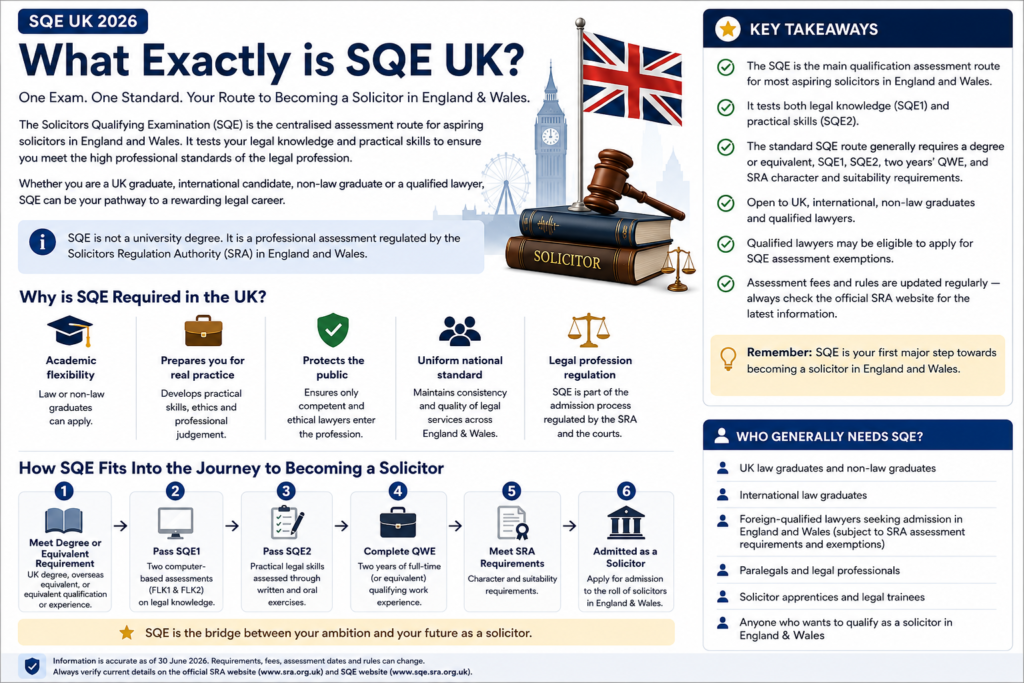
The Solicitors Qualifying Examination (SQE) is the centralised assessment used by most aspiring solicitors seeking admission in England and Wales.
Whether you are a UK graduate, an international candidate, a non-law graduate or a lawyer already qualified in another jurisdiction, understanding the SQE route is essential before planning your path to solicitor qualification.
Under the standard SQE route, candidates generally need a degree or equivalent qualification or experience, must pass SQE1 and SQE2, complete two years of full-time or equivalent qualifying work experience (QWE), and satisfy the Solicitors Regulation Authority’s character and suitability requirements.
Different requirements apply to qualified lawyers. UK and overseas qualified lawyers are not required to complete the standard two-year QWE requirement. Qualified lawyers may also be able to apply for an SQE assessment exemption where the SRA’s exemption requirements are met.
This SQE UK hub brings together practical guides on SQE eligibility, SQE1, SQE2, assessment fees, exam dates, qualifying work experience, exemptions and qualification pathways for candidates worldwide.
For Indian law graduates, advocates and legal professionals, dedicated sections below explain how the SQE route may apply when considering qualification as a solicitor of England and Wales.
What Is the SQE?
The Solicitors Qualifying Examination, commonly known as the SQE, is a centralised assessment for candidates seeking to qualify as solicitors in England and Wales.
The SQE was introduced on 1 September 2021 as part of the SRA’s framework for assessing aspiring solicitors against common standards.
The assessment has two stages:
- SQE1 assesses functioning legal knowledge.
- SQE2 assesses practical legal skills and the application of legal knowledge.
Passing the assessments alone does not automatically make a candidate a solicitor.
Candidates following the standard SQE route must also meet the relevant degree or equivalent requirement, complete the required qualifying work experience and satisfy the SRA’s character and suitability requirements before applying for admission to the roll of solicitors.
SQE Route at a Glance
For most candidates following the standard SQE route, the qualification pathway can be understood in five stages:
Degree or equivalent → Pass SQE1 → Pass SQE2 → Complete two years of QWE → Meet character and suitability requirements and apply for admission
A candidate’s route can differ if they are already a qualified lawyer or fall within the SRA’s transitional arrangements for an earlier route to qualification.
Eligible candidates who meet the relevant transitional requirements may continue to qualify through the LPC route until 2032.
SQE1 and SQE2: Understand the Two Assessment Stages
The SQE is divided into two assessment stages, but SQE1 and SQE2 test different aspects of solicitor competence.
SQE1
SQE1 focuses on functioning legal knowledge.
It is divided into two assessments:
- FLK1
- FLK2
Candidates are tested on their ability to apply fundamental legal principles and rules in realistic client-based and ethical situations.
SQE1 is a computer-based assessment using single best answer multiple-choice questions.
Candidates planning their first assessment should understand the assessment specification, examinable law and practice, assessment format and applicable sitting dates before booking.
Explore our complete SQE1 guide for the exam pattern, syllabus, assessment structure, preparation and key candidate requirements.
SQE2
SQE2 focuses on practical legal skills and the application of legal knowledge.
The assessment tests candidates through written and oral exercises.
Skills assessed include:
- Client interviewing
- Attendance note and legal analysis
- Advocacy
- Case and matter analysis
- Legal research
- Legal writing
- Legal drafting
SQE2 assesses whether candidates can demonstrate the practical skills expected at the standard of a newly qualified solicitor.
Read our detailed SQE2 guide for the assessment format, skills tested, preparation and candidate pathway.
Who Is Eligible for the SQE?
The SQE route is relevant to candidates from a wide range of academic and professional backgrounds.
This can include:
- UK law graduates
- UK non-law graduates
- International graduates
- Overseas law graduates
- Paralegals
- Solicitor apprentices
- Lawyers qualified in the UK or another jurisdiction
For admission through the standard SQE route, candidates need a UK degree in any subject, an overseas equivalent qualification, or a qualification or experience considered equivalent to the required level.
A qualifying law degree is not generally required for the standard SQE route. This means graduates from non-law disciplines can potentially pursue solicitor qualification, although they still need to develop the legal knowledge and practical skills required to pass the assessments.
Qualified lawyers follow a different qualification pathway and should review the SRA rules on assessments, exemptions and admission before deciding which SQE requirements apply to them.
A degree is not required merely to sit SQE1 or SQE2. However, candidates need a degree or equivalent, alongside the other applicable SRA requirements, to be admitted as a solicitor.
Check our SQE eligibility guide to understand the requirements for graduates, international candidates and qualified lawyers.
How Much Does the SQE Cost in 2026?
Candidates should separate official SQE assessment fees from the wider cost of preparing for qualification.
The published SQE assessment fees for assessments up to September 2026 are:
| Assessment | Official Assessment Fee |
|---|---|
| SQE1 | £1,934 |
| SQE2 | £2,974 |
| Total | £4,908 |
For assessments from September 2026 onwards, the published fees are:
| Assessment | Official Assessment Fee |
|---|---|
| SQE1 | £2,006 |
| SQE2 | £3,086 |
| Total | £5,092 |
All official SQE assessment fees are VAT exempt. SQE1 is paid as a single assessment fee covering FLK1 and FLK2.
These are assessment fees and do not include preparation courses, study materials, travel, accommodation, visa-related expenses or other personal costs.
International candidates should therefore calculate their wider financial commitment based on their preparation route, assessment location and travel requirements.
See our complete SQE fees and costs guide for current assessment charges, preparation expenses and budgeting considerations.
SQE Exam Dates and Assessment Locations
SQE1 and SQE2 assessments are offered during scheduled assessment windows.
Assessment dates, booking arrangements, law and practice cut-off dates and results dates can differ between sittings.
The official SQE assessment calendar publishes upcoming assessment windows and booking information.
SQE assessments are offered at test centres in the UK and internationally. However, availability can vary by assessment and location, and not every test centre is offered for every sitting.
Test-centre places are limited and allocated on a first come, first served basis.
Candidates travelling from another country should check the official assessment location and booking information before making non-refundable travel or accommodation arrangements.
View our SQE exam dates guide for current assessment windows, booking information and candidate planning updates.
What Is Qualifying Work Experience (QWE)?
Qualifying work experience is one of the core requirements of the standard SQE qualification route.
Most candidates following this route must complete a total of two years of full-time or equivalent QWE.
QWE involves experience of providing legal services and should give candidates the opportunity to develop some or all of the competences required to practise as a solicitor.
The experience can be gained across up to four organisations and may include relevant experience in settings such as:
- A law firm
- An in-house legal team
- A law centre
- A voluntary or charitable organisation providing legal services
- A placement during a law degree
- Relevant paralegal work
QWE can be gained before, during or after the SQE assessments. However, it must be completed and registered before a candidate applies for admission as a solicitor and must be confirmed in accordance with the SRA’s requirements.
Qualified lawyers are treated differently and are not required to complete the standard two-year QWE requirement.
Read our QWE guide to understand eligible experience, confirmation requirements and how qualifying work experience fits into the SQE route.
SQE for International Candidates and Foreign Lawyers
The SQE has significant relevance beyond the UK.
International graduates and lawyers qualified in other jurisdictions may consider the SQE when exploring qualification as a solicitor of England and Wales.
However, the correct route depends on the candidate’s existing academic and professional status.
International Graduates Who Are Not Qualified Lawyers
An international graduate who is not already professionally qualified as a lawyer will generally need to follow the standard SQE route.
This means meeting the degree or equivalent requirement for admission, passing SQE1 and SQE2, completing the required QWE and satisfying character and suitability requirements.
Candidates with overseas qualifications should check whether their qualification or experience meets the relevant SRA requirements.
Foreign-Qualified Lawyers
A lawyer already professionally qualified in another jurisdiction should consider the SRA’s qualified lawyer pathway.
Qualified lawyers generally need to meet the applicable degree or equivalent, SQE assessment, character and suitability, and admission requirements.
They do not need to complete the standard two-year QWE requirement and may be able to apply for an SQE assessment exemption where the SRA’s requirements are met.
An overseas legal qualification does not automatically create a blanket exemption from the SQE.
Candidates should check their individual qualification and exemption position before booking an assessment.
Can Foreign Lawyers Get an SQE Exemption?
Qualified lawyers may be able to apply for an exemption from part of the SQE where the SRA’s exemption requirements are met.
Exemptions are not automatic. The SRA considers the applicable exemption requirements and whether the candidate demonstrates the required equivalence for the assessment concerned.
Foreign-qualified lawyers should check their individual exemption position before booking an SQE assessment. For SQE2 exemptions, applicants must demonstrate the assessed skills to the same standard as candidates taking SQE2.
Explore our SQE exemptions guide for eligibility, assessment exemptions and SRA application requirements.
SQE for Indian Lawyers and Law Graduates
For Indian candidates, one distinction is particularly important when planning the SQE route:
Are you an Indian law graduate, or are you already a qualified lawyer with professional rights to practise?
The answer can materially affect the qualification route.
SQE for Indian LLB Graduates
An Indian LLB graduate who is not yet a qualified lawyer should not automatically assume that the SRA’s qualified lawyer rules apply.
Such candidates will generally need to consider the standard SQE route.
This can involve:
- Meeting the degree or equivalent requirement
- Passing SQE1
- Passing SQE2
- Completing two years of full-time or equivalent QWE
- Meeting character and suitability requirements
- Applying for admission as a solicitor
Indian candidates should distinguish between holding a law degree and holding a professional legal qualification that gives rights to practise.
A law degree alone does not automatically make a candidate a qualified lawyer for SQE exemption purposes.
SQE for Indian Advocates and Qualified Lawyers
Indian advocates or other legal professionals who hold a professional legal qualification giving rights to practise may need to consider the SRA’s qualified lawyer pathway.
Qualified lawyers do not complete the standard two-year QWE requirement. They generally need to meet the applicable SQE assessment and admission requirements, subject to any exemption approved by the SRA.
Indian advocates should not assume that professional qualification or years of legal practice automatically guarantee an SQE exemption. Exemption eligibility is assessed under the SRA’s applicable requirements.
QWE note for Indian candidates: Indian graduates following the standard SQE route generally need two years of full-time or equivalent QWE. Candidates treated as qualified lawyers under the SRA pathway are not subject to the standard QWE requirement.
Read our dedicated SQE for Indian lawyers guide to understand the route for Indian advocates and qualified legal professionals.
Can Indian Students and Lawyers Take the SQE?
International candidates, including candidates from India, can take the SQE, subject to the applicable registration, assessment and admission requirements.
Candidates should check official assessment locations for their relevant sitting because international test-centre availability can vary.
Before booking, Indian candidates should review:
- Their graduate or qualified lawyer status
- Degree or equivalent requirements for admission
- Applicable SQE assessment requirements
- Potential exemption eligibility
- QWE requirements
- Assessment fees
- Current assessment locations
- Travel and immigration requirements, where relevant
- Character and suitability requirements
Read our dedicated SQE for Indian lawyers guide for a step-by-step route based on your academic and professional status.
Where Should You Start With the SQE?
Your starting point depends on your academic and professional status.
UK or international graduate: Check the degree or equivalent requirement, then explore SQE1, SQE2 and QWE.
Non-law graduate: Review the functioning legal knowledge assessed in SQE1 and choose an appropriate preparation route.
Foreign-qualified lawyer: Check the SRA’s qualified lawyer pathway and possible assessment exemptions before booking.
Indian candidate: First determine whether you are applying as a graduate or as a qualified lawyer, as this can affect QWE and the relevance of exemption requirements.
Use the SQE guides on Lawsection.in to explore the route relevant to your current status.
Frequently Asked Questions About SQE UK
1. Is the SQE difficult to pass?
The SQE can be challenging because it tests the application of legal knowledge in SQE1 and practical legal skills in SQE2. Strong preparation and familiarity with the assessment format are important.
2. Can I take the SQE without a UK law degree?
Yes. A UK law degree is not generally required. A degree is not required merely to sit SQE1 or SQE2. However, to be admitted as a solicitor, candidates need a UK degree in any subject, an overseas equivalent qualification, or an equivalent qualification or experience recognised under SRA requirements.
3. Can international and Indian candidates take the SQE?
Yes. International and Indian candidates can take the SQE, subject to the applicable registration, assessment and admission requirements. The qualification pathway may differ for graduates and already qualified lawyers.
4. Do I need two years of QWE before taking the SQE?
No. QWE does not generally have to be completed before taking SQE1 or SQE2. However, candidates on the standard SQE route must complete two years of full-time or equivalent QWE before admission as a solicitor.
5. Can Indian or foreign-qualified lawyers get an SQE exemption?
Potentially. Qualified lawyers may apply for an SQE assessment exemption if they meet the SRA’s equivalence requirements. Exemptions are not automatic and depend on the candidate’s qualification, experience and supporting evidence.
Related Guides for Law Aspirants
Explore other law entrance, qualification and professional assessment guides:
- CLAT Exam: Complete Guide
- SLAT: Complete Guide
- AIBE Exam
- UGC NET Law Exam: Complete Guide
- NCA Exam Canada
- PLT Australia
These guides cover major law entrance, licensing and professional qualification pathways for students and legal professionals in India and internationally.
Editorial Review & Accuracy Statement
This guide has been researched and reviewed by the Lawsection.in Editorial Team to provide accurate, practical and easy-to-understand information about the Solicitors Qualifying Examination (SQE) and the solicitor qualification route in England and Wales.
Every effort has been made to ensure the content reflects current Solicitors Regulation Authority (SRA) requirements and official SQE guidance as of July 06, 2026.
Because SQE assessment rules, fees, exam dates, qualifying work experience requirements, exemption policies and admission requirements may change, readers should always verify the latest information with the SRA and the official SQE website before making academic, professional, financial or qualification-related decisions.
