
PLT Australia (Practical Legal Training): Complete Guide for Domestic & International Law Graduates (2026)
If you want to become a lawyer in Australia, understanding Practical Legal Training (PLT) is one of the most important steps in your professional journey. For many aspiring solicitors, completing an approved law degree is only part of the admission pathway. Before applying for admission to the legal profession, eligible graduates generally need to satisfy additional practical training requirements, which commonly include completing an approved Practical Legal Training (PLT) program, alongside meeting the admission requirements of the relevant Australian jurisdiction.
Whether you are an Australian law graduate, an international student, an Indian LL.B. graduate, a foreign-qualified lawyer, or someone planning to study law in Australia, this comprehensive guide explains everything you need to know about PLT Australia. You’ll learn what PLT is, who needs it, eligibility requirements, approved providers, practical workplace training, fees, duration, admission pathways, career opportunities, and how the process may differ for overseas-qualified applicants.
Unlike many general overviews, this guide combines Australian legal admission principles, practical career guidance, and international pathways into one structured resource. It is designed to help readers understand the Australian legal profession while avoiding common misconceptions about becoming a solicitor in Australia.
Editorial Note: Admission to the Australian legal profession is regulated at the state and territory level. Individual admission requirements may differ depending on the admitting authority and a person’s academic qualifications, including whether their law degree was completed in Australia or overseas. Applicants should always confirm current requirements with the relevant admitting authority before making education or career decisions.
What is PLT Australia?
PLT Australia (Practical Legal Training) is a professionally focused legal training program that helps eligible law graduates develop the practical knowledge, professional skills, ethical understanding, and workplace experience expected before admission to the legal profession. In most Australian jurisdictions, completing an approved PLT program (or another recognised pathway, where applicable), together with meeting the relevant admission requirements, forms part of the process for applying for admission as a lawyer.
PLT programs typically combine practical legal coursework with supervised workplace experience, preparing graduates for real-world legal practice across areas such as client communication, legal drafting, advocacy, negotiation, professional ethics, legal research, and practice management.
PLT Australia at a Glance
| Feature | Details |
|---|---|
| Full Form | Practical Legal Training (PLT) |
| Country | Australia |
| Primary Purpose | Practical vocational training supporting admission to the Australian legal profession |
| Who May Need PLT? | Many Australian law graduates and some overseas-qualified applicants, depending on the requirements of the relevant admitting authority |
| Typical Entry Qualification | Completion of the required academic law qualifications recognised for admission in the relevant jurisdiction |
| Study Modes | Online, on-campus, blended (provider dependent) |
| Practical Component | Supervised workplace experience or an approved practical training component as required by the provider |
| Program Length | Varies by provider, study mode, and enrolment pattern |
| Fees | Vary by approved provider and program |
| Outcome | Supports eligibility to apply for admission to the legal profession, subject to satisfying all applicable admission requirements |
| Admission Authority | State and Territory admitting authorities and the relevant Supreme Court processes |
| Ideal For | Australian law graduates, international law students, overseas-qualified lawyers, and Indian graduates exploring Australian legal careers |
| Best For | Individuals planning to qualify as a solicitor in Australia through the applicable admission pathway |
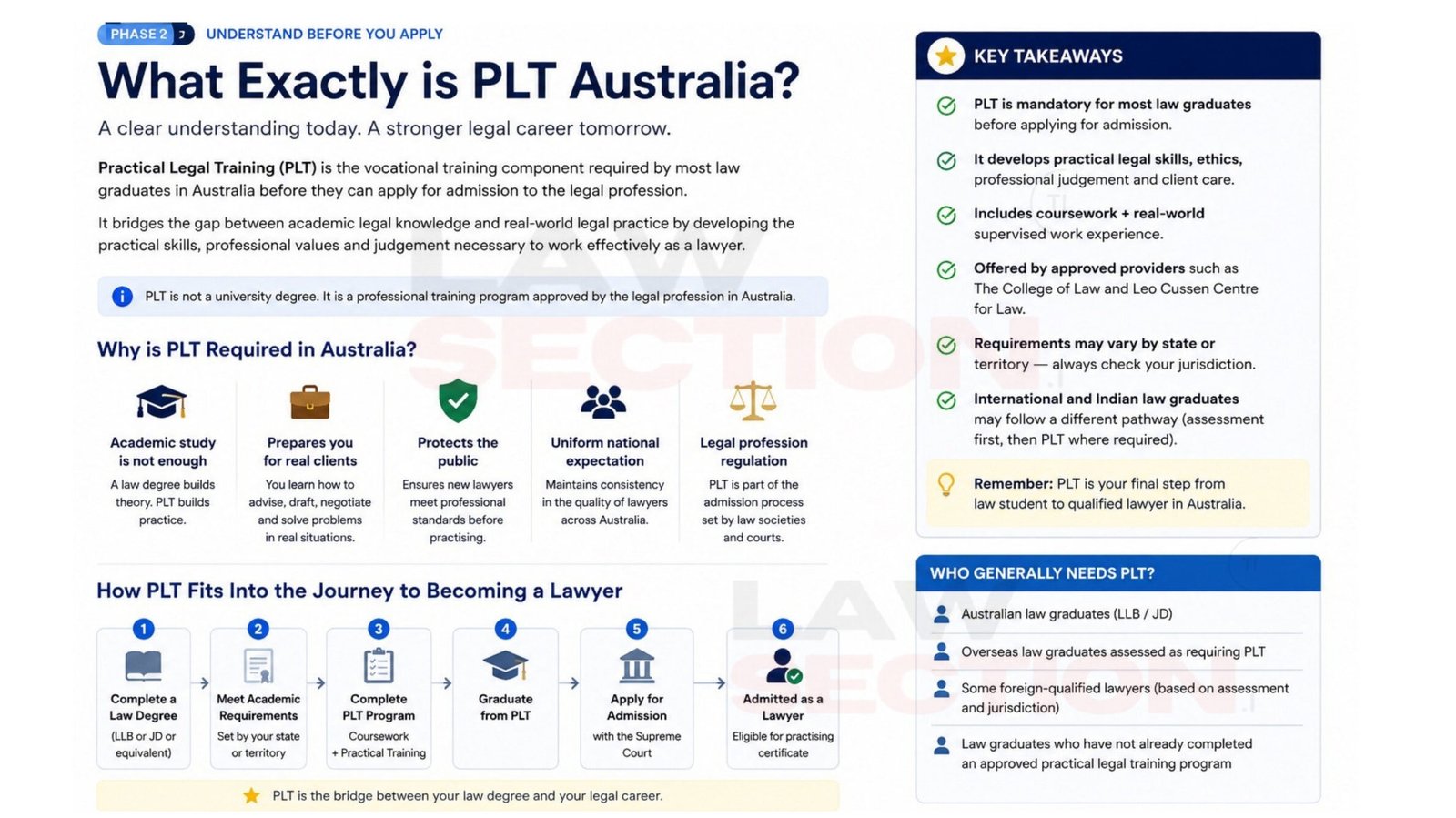
Who Usually Needs PLT?
The answer depends on your qualifications and the Australian jurisdiction in which you intend to seek admission.
In general, PLT may be relevant for:
- Australian LL.B. graduates seeking admission
- Australian J.D. graduates seeking admission
- Overseas law graduates whose qualifications have been assessed and who are required to complete PLT
- Foreign-qualified lawyers where the relevant admitting authority requires PLT or part of a PLT program as part of the admission pathway
Importantly, not every international graduate follows the same route.
If you completed your law degree outside Australia—including in India—you should first obtain an assessment from the relevant admitting authority in the Australian state or territory where you intend to seek admission. That authority will determine whether you must complete additional academic subjects, PLT, both, or other requirements before becoming eligible to apply for admission.
Which PLT Australia Pathway Is Right for You?
Not every applicant follows the same route to becoming an Australian lawyer. Your pathway to Practical Legal Training (PLT) depends on where you completed your legal education, whether you are already admitted to practise law, and the assessment requirements of the Australian state or territory in which you intend to seek admission.
Use the guide below to identify the pathway that best matches your background before enrolling in a PLT program.
Important: Completing PLT alone does not automatically qualify a person to practise law in Australia. Applicants must also satisfy the academic requirements, meet the relevant admitting authority’s requirements, demonstrate they are a fit and proper person, be admitted by the relevant Supreme Court, and obtain a practising certificate before providing legal services. Requirements vary slightly between Australian jurisdictions.
Pathway 1 — Australian Law Graduates (LL.B. or J.D.)
Best for:
- Australian Bachelor of Laws (LL.B.) graduates
- Australian Juris Doctor (J.D.) graduates
- Final-year eligible students (where permitted by the relevant admitting authority)
Typical Journey for Australian Law Graduates
Outcome: Once admitted and holding the required practising certificate, you may practise as a lawyer in accordance with the laws and regulatory requirements of the relevant Australian jurisdiction.
What You Should Know
- This is the standard pathway followed by most domestic law graduates.
- PLT focuses on practical legal skills such as client interviewing, advocacy, drafting, negotiation, ethics, legal research, dispute resolution, and professional responsibility.
- After successfully completing PLT, eligible graduates may apply for admission through the relevant admitting authority in the Australian state or territory where they intend to practise.
Pathway 2 — International Law Graduates (Not Yet Admitted Overseas)
Best for:
- Graduates who earned a law degree outside Australia
- International students planning to qualify as Australian lawyers
- Many overseas LL.B. graduates, including those from India, depending on individual assessment
Typical Journey for International Law Graduates
Outcome: Once your overseas qualifications have been assessed, all required academic and practical requirements have been completed, you have been admitted by the relevant Supreme Court, and you hold the required practising certificate, you may practise as a lawyer in accordance with the laws and regulatory requirements of the relevant Australian jurisdiction.
What You Should Know
Your overseas law degree is not automatically recognised for admission purposes.
Instead, the relevant admitting authority evaluates your academic qualifications against Australian admission requirements. Following that assessment, you may be required to:
- complete no additional academic study;
- complete specified Australian law subjects;
- complete an approved PLT program;
- or complete a combination of academic and practical requirements before applying for admission.
The exact outcome depends on your educational background, jurisdiction, and the admitting authority responsible for your application.
Good to know for Indian law graduates: Many graduates from India begin with an academic assessment rather than applying directly to a PLT provider. Whether PLT is required—and when—depends on the assessment issued by the relevant Australian admitting authority.
Pathway 3 — Overseas Qualified Lawyers
Best for:
- Lawyers already admitted to practise outside Australia
- Solicitors and advocates seeking admission in Australia
Typical Journey for Overseas Qualified Lawyers
Outcome: Once you satisfy the admission requirements of the relevant Australian jurisdiction and obtain the necessary practising certificate, you may practise law in Australia in accordance with the applicable laws, professional standards, and regulatory requirements.
What You Should Know
Being admitted as a lawyer in another country does not automatically entitle you to practise Australian law.
The relevant admitting authority will assess your existing qualifications, legal training, and, where applicable, your previous practical legal training. Depending on the assessment, you may receive exemptions, be required to complete additional academic study, complete part or all of a PLT program, or satisfy other jurisdiction-specific requirements before becoming eligible for admission.
Pathway 4 — International Students Completing an Australian Law Degree
Best for:
- International students studying an Australian LL.B.
- International students completing an Australian J.D.
Typical Journey for International Students Completing an Australian Law Degree
Outcome: International graduates who successfully complete an approved Australian law degree, satisfy the admission requirements, are admitted by the relevant Supreme Court, and obtain a practising certificate may practise law in Australia, subject to the laws and professional regulations of the relevant jurisdiction. Immigration status and work rights remain governed by Australia’s migration laws and are separate from legal admission.
What You Should Know
International students who complete an approved Australian law degree generally follow the same professional pathway as domestic graduates. However, they should also plan for practical matters such as visa status, graduate employment, and compliance with Australian immigration requirements alongside the admission process. Immigration requirements operate separately from legal admission requirements and should always be verified through official government sources.
Quick Comparison of All PLT Australia Pathways
| Applicant Type | Academic Assessment Required? | PLT Required?* | Admission Possible? |
|---|---|---|---|
| Australian LL.B./J.D. Graduate | Usually No | Yes | Yes |
| Overseas Law Graduate | Usually Yes | Depends on assessment | Yes, if all requirements are met |
| Overseas Qualified Lawyer | Yes | Depends on assessment | Yes, if all requirements are met |
| International Student with Australian Law Degree | Usually No | Yes | Yes |
*Important: Whether PLT is required—and whether the full program or only certain components must be completed—depends on the decision of the relevant admitting authority in the Australian jurisdiction where you seek admission. Never enrol in a PLT program before confirming your assessment outcome if you hold overseas qualifications.
Choose the Right PLT Australia Provider: A Practical Decision Guide
Choosing the right Practical Legal Training (PLT) provider is one of the most important decisions on your journey to becoming a lawyer in Australia. While every accredited PLT program is designed to help eligible law graduates satisfy the practical training requirement for admission, the learning experience, teaching approach, flexibility, student support, placement assistance, and career services can vary significantly between providers.
For domestic students, international students, and overseas-qualified lawyers—including law graduates from India—the best PLT provider is not necessarily the cheapest or the fastest. Instead, it is the provider that best matches your career goals, preferred learning style, location, schedule, and admission pathway.
How to Choose the Best PLT Provider
Before enrolling, compare providers using the following factors instead of focusing only on tuition fees.
| Decision Factor | Why It Matters | Best For |
|---|---|---|
| Accreditation | Ensure the PLT program is recognised by the relevant admitting authority for your intended jurisdiction. | Every applicant |
| Study Mode | Providers may offer online, on-campus, hybrid, full-time or part-time options. | Working professionals, international students |
| Program Flexibility | Flexible schedules help balance employment, internships and family commitments. | Students with other commitments |
| Practical Skills Training | Look for strong training in client interviewing, drafting, advocacy, negotiation, ethics and legal practice management. | Future solicitors and commercial lawyers |
| Work Placement Support | Some providers offer structured guidance or placement assistance, while others expect students to organise placements themselves. | International graduates and students without legal networks |
| Teaching Faculty | Programs taught by experienced practising lawyers can provide valuable real-world insights. | Career-focused graduates |
| Career Services | Resume reviews, interview coaching, networking events and graduate employment support can improve job readiness. | First-time legal job seekers |
| Graduate Reputation | Alumni outcomes, employer recognition and graduate satisfaction provide useful indicators of program quality. | All applicants |
| Location & Accessibility | Consider whether you need campus access or prefer fully online learning. | Interstate and overseas students |
| Overall Value | Compare the complete learning experience—not just tuition fees. | Every applicant |
A Simple 5-Step Checklist Before You Enrol
Before accepting an offer, ask yourself these questions:
- Is this PLT program recognised for admission in the Australian jurisdiction where I intend to practise?
- Does the study mode fit my work, family or visa commitments?
- What practical legal skills will I develop beyond the minimum admission requirements?
- What level of work placement and career support is available?
- Does the provider have a strong reputation among graduates and employers?
If you can confidently answer “Yes” to all five questions, you are more likely to choose a PLT program that supports both your admission goals and your long-term legal career.
Special Advice for International Students and Indian Law Graduates
If you completed your law degree outside Australia—such as in India, the United Kingdom, Canada, Singapore or another jurisdiction—do not enrol in a PLT program solely because you hold an LL.B. or equivalent qualification.
In many cases, overseas-qualified applicants must first obtain an assessment of their academic qualifications from the relevant admitting authority. Depending on that assessment, you may be required to complete additional academic subjects before becoming eligible for PLT or admission. The exact pathway varies by jurisdiction and individual circumstances.
For most Indian law graduates, the recommended sequence is:
- Complete your Indian law qualification.
- Obtain an assessment from the relevant Australian admitting authority.
- Complete any prescribed academic requirements (if required).
- Enrol in an appropriate accredited PLT program (if required).
- Apply for admission to the legal profession after satisfying all applicable requirements.
Following this order can help avoid unnecessary costs, delays and enrolment in a program that may not yet be appropriate for your admission pathway.
PLT Australia Costs Explained (2026): Complete Budget Guide for Domestic & International Law Graduates
Understanding the total cost of Practical Legal Training (PLT) in Australia is essential before you apply. Many applicants focus only on tuition fees, but the actual budget may also include application fees, study materials, practical training expenses, admission costs, and practising certificate fees after completing PLT.
PLT Australia Cost at a Glance (2026)
| Expense Category | Typical Requirement | Notes |
|---|---|---|
| PLT Tuition Fees | Mandatory | Usually the largest expense and varies by provider and study mode. |
| Application or Enrolment Fees | May apply | Some providers charge separate administrative or enrolment fees. |
| Learning Resources | May apply | Printed materials, online resources, or software access may be included or charged separately. |
| Practical Training or Placement Expenses | Often applicable | Travel, accommodation, transport, and daily living costs during work experience may arise depending on placement location. |
| Graduation or Completion Fees | Provider-dependent | Some providers may charge completion or graduation-related fees. |
| Admission Application Fees | Mandatory | Payable when applying for admission to the legal profession through the relevant admission authority. |
| Character Assessment Costs | May apply | Supporting documents, certifications, or other compliance-related expenses may be required depending on individual circumstances. |
| Practising Certificate Fees | Usually required after admission | Payable to the relevant legal profession regulator before commencing legal practice, where applicable. |
Important: Fee structures, payment schedules, and included services differ between PLT providers and Australian jurisdictions. Always confirm the latest information directly with your chosen provider and the relevant admission authority before enrolling.
Cost Differences Between Domestic and International Students
Your overall budget will depend on your personal pathway.
Australian Law Graduates
Typical expenses generally include:
- PLT tuition
- Admission fees
- Practising certificate fees
- Living expenses during study (if applicable)
International Law Graduates
In addition to the above, international graduates may also need to budget for:
- Qualification assessment processes
- Additional academic subjects if required by the relevant admission authority
- Student visa and related costs (where applicable)
- Health insurance requirements (where applicable)
- International travel
- Relocation and accommodation
- Currency exchange fluctuations
Not every internationally qualified lawyer follows the same pathway. Academic recognition and any additional requirements depend on the relevant Australian jurisdiction and the individual’s qualifications.
Complete Admission Roadmap: How to Become a Lawyer Through PLT Australia
Whether you are an Australian law graduate, an international student, or an overseas-qualified lawyer from India or another country, becoming an Australian lawyer involves a structured admission process. Although the exact pathway may differ depending on your academic qualifications, the Australian state or territory where you seek admission, and whether your law degree was obtained in Australia or overseas, the roadmap below explains the journey followed by most applicants.
Step 1: Complete Your Law Degree or Obtain Qualification Assessment
Your journey starts with your legal education.
Depending on your background, this usually means one of the following:
For Australian Students
- Complete an approved Bachelor of Laws (LLB) or Juris Doctor (JD) that satisfies the required academic standards for admission.
For International Students Studying in Australia
- Complete an Australian law qualification that meets the academic requirements of the relevant admitting authority.
For Overseas-Qualified Lawyers (Including Indian Lawyers)
- Apply to the relevant state or territory admitting authority for an assessment of your overseas legal qualifications.
- The authority will determine whether your existing qualifications are substantially equivalent to Australian academic requirements or whether additional study is required before you can proceed.
Step 2: Meet Any Required Academic Conditions
Before enrolling in PLT, ensure that you have completed all academic requirements specified by the relevant admitting authority.
Depending on your circumstances, you may need to:
- complete all prescribed academic subjects;
- satisfy any additional coursework required after an overseas qualification assessment; or
- provide official academic transcripts and supporting documentation.
Step 3: Complete an Approved Practical Legal Training (PLT) Program
After meeting the academic requirements, the next stage is to complete an approved Practical Legal Training (PLT)program.
PLT focuses on developing the practical skills expected of an entry-level lawyer, including:
- client interviewing and communication;
- legal drafting;
- legal research;
- advocacy and negotiation;
- ethics and professional responsibility;
- file and matter management; and
- practical workplace experience or its approved equivalent, depending on the provider and jurisdiction.
Many approved providers offer flexible study options, including online, hybrid, part-time, and full-time delivery. The exact structure, duration, and placement requirements vary between providers and jurisdictions.
Step 4: Demonstrate That You Are a Fit and Proper Person
Admission to the Australian legal profession is not based solely on academic achievement.
Applicants must also satisfy the admitting authority and the relevant Supreme Court that they are a fit and proper personto be admitted.
This assessment generally considers matters such as:
- honesty and integrity;
- professional conduct;
- disclosure of relevant criminal or disciplinary history;
- compliance with admission requirements; and
- other matters that may affect suitability for legal practice.
Applicants are expected to make full and accurate disclosures where required.
Step 5: Apply for Admission to the Legal Profession
Once you have completed the required academic and practical training requirements, you may apply for admission through the relevant admitting authority in the Australian state or territory where you intend to practise.
Although procedures differ across jurisdictions, applications commonly require evidence of:
- approved academic qualifications;
- successful completion of PLT (where required);
- identity documentation;
- character and suitability disclosures; and
- other documents specified by the admitting authority.
Admission is ultimately granted by the relevant Supreme Court.
Step 6: Attend the Admission Ceremony
If your application is approved, you will normally attend an admission ceremony conducted by the relevant Supreme Court.
During this ceremony, applicants typically:
- take an oath or affirmation;
- sign the Supreme Court Roll; and
- are formally admitted as Australian lawyers.
This is an important professional milestone, but admission alone does not automatically authorise you to provide legal services to the public.
Step 7: Obtain a Practising Certificate
After admission, lawyers who intend to practise must obtain a current practising certificate from the appropriate law society, bar association, or other authorised body in the relevant jurisdiction.
Only after holding the required practising certificate (subject to applicable legal exceptions) may a lawyer engage in legal practice in accordance with the laws of that jurisdiction.
Career Opportunities After PLT Australia
Completing Practical Legal Training (PLT) is a significant milestone on the journey to becoming a legal professional in Australia. After successfully completing PLT and meeting the applicable admission requirements of the relevant Australian state or territory—including admission to the legal profession and, where required, obtaining a practising certificate—you may become eligible to pursue a wide range of legal careers across private practice, government, corporations, academia, public interest organisations, and emerging legal technology sectors.
| Career Path | Typical Role | Admission Required?* | Suitable For |
|---|---|---|---|
| Solicitor | Advise clients, prepare legal documents, represent clients where authorised | Yes | Australian graduates, international graduates, overseas-qualified lawyers |
| Lawyer in a Law Firm | Work in commercial, family, criminal, property, employment, or other practice areas | Yes | New and experienced lawyers |
| Government Lawyer | Provide legal advice to government departments, regulators, or statutory authorities | Usually Yes | Public sector professionals |
| In-house Legal Counsel | Advise companies on contracts, compliance, governance, employment, and risk | Usually Yes | Corporate law professionals |
| Corporate Legal Advisor | Support business operations, commercial transactions, and regulatory compliance | Role-dependent | Lawyers and experienced legal professionals |
| Compliance Officer | Manage legal and regulatory compliance programs across organisations | Not always | Law graduates and legal professionals |
| Risk & Governance Specialist | Oversee legal risk, corporate governance, and internal controls | Not always | Corporate and financial services professionals |
| Legal Consultant | Provide specialist legal or regulatory advice within permitted legal and professional frameworks | Depends on services provided | Experienced professionals |
| Immigration Law Professional | Work in immigration law practices or related legal support roles (subject to applicable regulatory requirements) | Usually Yes for legal practice | Lawyers interested in migration law |
| Banking & Financial Services Legal Professional | Support lending, finance, regulatory, and commercial legal matters | Usually Yes | Corporate lawyers |
| Property & Real Estate Lawyer | Handle conveyancing, leasing, development, and property transactions | Yes | Property law specialists |
| Commercial Lawyer | Advise businesses on commercial contracts, mergers, procurement, and transactions | Yes | Corporate law professionals |
| Employment Lawyer | Advise on workplace relations, discrimination, employment contracts, and disputes | Yes | Employment law specialists |
| Family Lawyer | Handle family law matters including divorce, parenting, and property settlements | Yes | Family law practitioners |
| Criminal Lawyer | Represent clients in criminal investigations and court proceedings | Yes | Criminal law specialists |
| Community Legal Centre Lawyer | Deliver legal assistance to individuals and communities through not-for-profit legal services | Yes | Public interest lawyers |
| Legal Academic or Researcher | Teach law, undertake legal research, publish scholarly work, and contribute to policy | Not always | Academics and researchers |
| Legal Policy Officer | Develop legislation, legal policy, and regulatory reform initiatives | Usually No | Government and policy professionals |
| Alternative Dispute Resolution Professional | Support mediation, negotiation, and dispute resolution processes (subject to accreditation requirements where applicable) | Role-dependent | Dispute resolution specialists |
| Legal Technology (LegalTech) Professional | Work in AI, legal operations, contract automation, compliance technology, and innovation | Not always | Technology-focused law graduates |
Important: Completing PLT is an important step, but it is not, by itself, a licence to practise law. Before providing legal services as an Australian lawyer, you must satisfy the admission requirements of the relevant jurisdiction and, where required, hold a current practising certificate.
Frequently Asked Questions (FAQs)
1. What is PLT Australia?
PLT (Practical Legal Training) is the practical vocational training that eligible law graduates complete before applying for admission to the legal profession in Australia.
2. Is PLT mandatory in Australia?
For most admission pathways, yes. Eligible graduates are generally required to complete approved practical training before seeking admission to the legal profession.
3. Can international students complete PLT in Australia?
Yes—provided they first satisfy the academic and eligibility requirements determined by the relevant admitting authority.
4. Can Indian LL.B. graduates enrol directly in PLT?
Most Indian law graduates first undergo an assessment of their legal qualifications. Depending on the outcome, additional prescribed academic subjects may be required before becoming eligible for PLT.
5. How long does PLT take?
| Study Mode | Typical Duration |
|---|---|
| Full-time | Varies by provider |
| Part-time | Longer duration |
| Online | Flexible |
| On-campus | Structured schedule |
Related Guide for Law Aspirants
Editorial Review & Accuracy Statement
This guide has been researched and reviewed by the Lawsection.in Editorial Team to provide accurate, practical, and easy-to-understand information about Practical Legal Training (PLT) in Australia. Every effort has been made to ensure the content reflects official legal education and admission requirements. Because admission rules, PLT provider policies, fees, and regulatory requirements may change and can differ between Australian states and territories, readers should always verify the latest information with the relevant admitting authority, approved PLT provider, or official government source before making academic, professional, or immigration-related decisions.
