
AIBE XXI Syllabus 2026 – Complete Syllabus, Subject-wise Weightage & Pattern
Reviewed by Rajni Bala, Assistant Professor of Law | Academic Review Panel
Last Updated: April 16, 2026
The All India Bar Examination (AIBE) 2026 is the national qualifying test conducted by the Bar Council of India (BCI) for law graduates seeking the Certificate of Practice (CoP) to practice law in Indian courts.
AIBE XXI (21) registration begins on 11 February 2026, and the examination is officially scheduled to be conducted on 7 June 2026.
For complete details, read the full guide on AIBE XXI (21) 2026
Quick Answer:
The AIBE XXI (2026) syllabus includes 19 core law subjects such as Constitutional Law, IPC/BNS, CrPC/BNSS, CPC, Evidence, and Professional Ethics. The exam consists of 100 questions, with most weightage given to core procedural and criminal laws. Only Bare Acts without notes are allowed, making conceptual clarity and section-based preparation crucial.
Explore more -> Eligibility Criteria | AIBE Syllabus | Exam Pattern | Result & Cut-off | Bare Acts for AIBE | Preparation Strategy
AIBE XXI Registration Begins February 11; Exam Scheduled for June 7
The Bar Council of India has officially announced that AIBE XXI (21) registration will commence from 11 February 2026, while the examination is scheduled to be conducted on 7 June 2026.
Candidates must complete the online application process within the prescribed deadline once the official notification is released. It is advisable to apply early to avoid last-minute technical issues.
The AIBE XXI 2026 exam will be conducted in offline OMR mode across designated centres in India.
AIBE XXI Syllabus 2026 – Quick Overview
| Feature | Detail |
|---|---|
| Exam Name | AIBE XXI (21) 2026 (given link to read full guide about AIBE XXI) |
| Conducting Body | Bar Council of India |
| Exam Date | 7 June 2026 (Official) |
| Registration Start Date | 11 February 2026 (Official) |
| Mode | Offline – OMR-based |
| Questions | 100 MCQs |
| Marking Scheme | 1 mark per question |
| Negative Marking | None |
| Duration | 3 Hours 30 Minutes |
| Qualifying Marks | General/OBC-45%, SC/ST/PwD 40% |
| Languages | English + Regional languages |
The AIBE Exam 2026 syllabus consists of 19 core law subjects drawn from LLB curriculum.
How Many Subjects Are There in AIBE XXI Syllabus 2026?
The AIBE XXI syllabus 2026 consists of 19 law subjects prescribed by the Bar Council of India (BCI). The examination includes core law subjects studied during the LL.B. degree such as Constitutional Law, Criminal Law, Civil Procedure Code, Evidence Act, Professional Ethics, and Property Law.
The AIBE exam contains 100 multiple-choice questions based on these subjects and candidates must secure the minimum qualifying marks to obtain the Certificate of Practice (COP).
Is the AIBE XXI Syllabus the Same Every Year?
Yes, the AIBE syllabus generally remains consistent every year because it is based on core subjects taught in the LL.B. degree. However, the Bar Council of India may slightly adjust the subject weightage or number of questions in certain subjects.
Candidates should always refer to the latest official AIBE XXI notification released by the Bar Council of India before starting preparation.
AIBE XXI Syllabus 2026– Subjects & Weightage
The AIBE 2026 syllabus includes 19 subjects, with highest weightage given to Constitutional Law, CPC, and CrPC (around 10 questions each), followed by IPC, Evidence Act, and Contract Law (6–8 questions). Other subjects like Family Law, Tort, and Professional Ethics carry moderate weightage, while Company Law, Cyber Law, and IPR have lower weightage.
Below is the subject-wise distribution of questions in AIBE XXI 2026:
| Subject / Topic | Approx. No. of Questions / Marks |
|---|---|
| Constitutional Law | 10 |
| Criminal Procedure Code / Bharatiya Nagarik Suraksha Sanhita | 10 |
| Indian Penal Code / Bharatiya Nyaya Sanhita | 8 |
| Civil Procedure Code (CPC) | 10 |
| Law of Contract, Specific Relief, Property Laws & Negotiable Instruments Act | 8 |
| Family Law (Hindu, Muslim, Special Marriage Act etc.) | 8 |
| Evidence Act / Bharatiya Sakshya Adhiniyam | 8 |
| Professional Ethics & BCI Rules | 4 |
| Company Law | 2 |
| Environmental Law | 2 |
| Cyber Law | 2 |
| Labour & Industrial Laws | 4 |
| Law of Tort, Motor Vehicles Act & Consumer Protection Law | 5 |
| Taxation Law | 4 |
| Land Acquisition Act | 2 |
| Intellectual Property Laws | 2 |
| (Additional subjects combined to total 19 subjects) | — |
Important Note: This is the updated structure for AIBE XXI (21) based on official pattern trends and syllabus release analysis for AIBE 2026. Subject listings and weightage reflect the latest BCI guidelines.
Deep Dive: Key Topics per Subject
1. Constitutional Law
- Fundamental Rights & Writs
- DPSPs vs Fundamental Rights
- Amendment Powers of Parliament
- Jurisdiction of Supreme Court & High Courts
- Emergency Provisions
- Landmark case principles
2. Code of Civil Procedure
- Jurisdiction of courts
- Res judicata & res sub judice
- Pleadings, Plaint, Written Statement
- Appeals, Review, Revision
- Execution of decrees
3. CrPC / BNSS
- Arrest, Bail, FIR
- Cognizable vs Non-cognizable offences
- Trial procedure
- Powers of Magistrate
- Charge & investigation
4. IPC / BNS
- General Exceptions
- Common intention & common object
- Offences against body & property
- Criminal breach of trust, cheating
5. Evidence Act / BSA
- Relevancy of facts
- Admissions & Confessions
- Burden of proof
- Examination of witnesses
- Documentary evidence
6. Contract, Property & Specific Relief
- Essentials of valid contract
- Void & voidable agreements
- Specific performance
- Sale, mortgage, lease basics
7. Family Law
- Hindu Marriage & Divorce
- Muslim marriage & maintenance
- Guardianship & adoption
- Special Marriage Act basics
8. Professional Ethics & BCI Rules
- Duties of advocate to court, client, opponent
- Misconduct rules
- Advertising prohibition
- Dress code & conduct
9. Tort, Consumer, MV Act, Labour, Tax, IPR, Cyber, Environment
These are direct theory questions from bare act definitions.
(This guide covers the crucial portions; candidates should study full bare acts for each subject because AIBE is a Bare Act-based exam, not a conceptual law entrance test.
AIBE XXI Subject-Wise Weightage 2026
| Category | Weightage Level |
|---|---|
| Very High | Constitutional Law, CPC, CrPC |
| High | Contract Law, Evidence, IPC |
| Moderate | Family Law, Tort, Professional Ethics |
| Low | Company & Cyber Law variants |
This helps prioritise preparation strategy.
Which Subjects Should You Focus More in AIBE 2026? (Expert Strategy)
If your goal is to pass AIBE in the first attempt, focus on:
- Core Bare Act subjects (IPC/BNS, CrPC/BNSS, CPC, Evidence/BSA)
- Frequently repeated sections and provisions
- Practical law subjects used in litigation
Avoid wasting time on:
- Rarely asked minor laws
- Theoretical-only topics without Bare Act relevance
AIBE Syllabus 2026 PDF Download (Official & Free)
The official AIBE XXI (21) 2026 syllabus PDF will be available on the Bar Council of India portal along with the registration notification starting from 11 February 2026.
Biggest Mistake Students Make While Preparing AIBE Syllabus
Most candidates preparing for AIBE 2026 make a critical mistake that significantly reduces their chances of passing — they try to cover all subjects equally without understanding the real weightage and nature of the exam.
Unlike other law entrance or competitive exams, AIBE is not designed to test theoretical knowledge across all subjects in depth. Instead, it focuses on practical understanding of Bare Acts and frequently used legal provisions from selected high-weightage subjects such as Constitutional Law, IPC, CrPC, CPC, and Evidence.
When candidates divide their time equally across all subjects, they end up under-preparing the most important areas while over-investing effort in low-weightage topics. This leads to confusion during the exam, slower question-solving, and ultimately lower scores despite completing the syllabus.
The correct approach is not to study everything equally, but to study strategically — focusing more on high-impact subjects, understanding Bare Act language, and recognizing patterns of frequently asked provisions.
How to Pass AIBE 2026 in First Attempt (Real Strategy)
Passing AIBE 2026 in the first attempt is completely achievable if the preparation is aligned with the actual exam pattern and evaluation style used by the Bar Council of India.
The most effective strategy begins with prioritising Bare Act-based preparation. Since the exam allows unmarked Bare Acts inside the examination hall, the focus should be on developing familiarity with sections, headings, and structure of important laws rather than relying on coaching notes or summaries.
Another crucial element is concentrating on high-weightage subjects where most questions are asked. Building strong command over procedural and criminal laws ensures that a significant portion of the paper can be attempted with confidence and accuracy.
Consistent practice with section-based questions improves speed and helps in quickly locating answers within Bare Acts during the exam. Over time, this reduces dependency on memory and enhances practical problem-solving ability.
Finally, revision plays a decisive role. Instead of repeatedly covering new topics, revisiting important provisions and frequently asked sections ensures better retention and higher accuracy on exam day.
AIBE is not a difficult exam, but it demands a smart and focused approach. Candidates who align their preparation with the real exam pattern and avoid unnecessary complexity are far more likely to clear the exam in their very first attempt.
Important AIBE Exam Guides
If you are preparing for the All India Bar Examination, you should also read these detailed guides:
- AIBE 2026 Result, Cut-Off & Certificate of Practice (COP) Process
- What Happens If You Fail AIBE? Career Impact & Legal Position Explained
- Can You Practice Law Without AIBE? BCI Rules & Penalties Explained
- Can Final Year LLB Students Apply for AIBE? Eligibility Rules Explained
People Also Search For
- AIBE XXI syllabus 2026 PDF
- AIBE XXI exam pattern 2026
- How many subjects are in AIBE exam
- AIBE passing marks 2026
- Is AIBE exam difficult
- Bare Acts allowed in AIBE exam
Frequently Asked Questions (FAQs)
1. Is AIBE 2026 an open book exam?
Yes. AIBE 2026 is conducted as an open book examination. Candidates are allowed to carry bare acts without notes or written commentary inside the exam hall. However, guidebooks, solved papers, handwritten notes, and printed summaries are strictly prohibited. Candidates must rely primarily on their understanding of the Bare Acts.
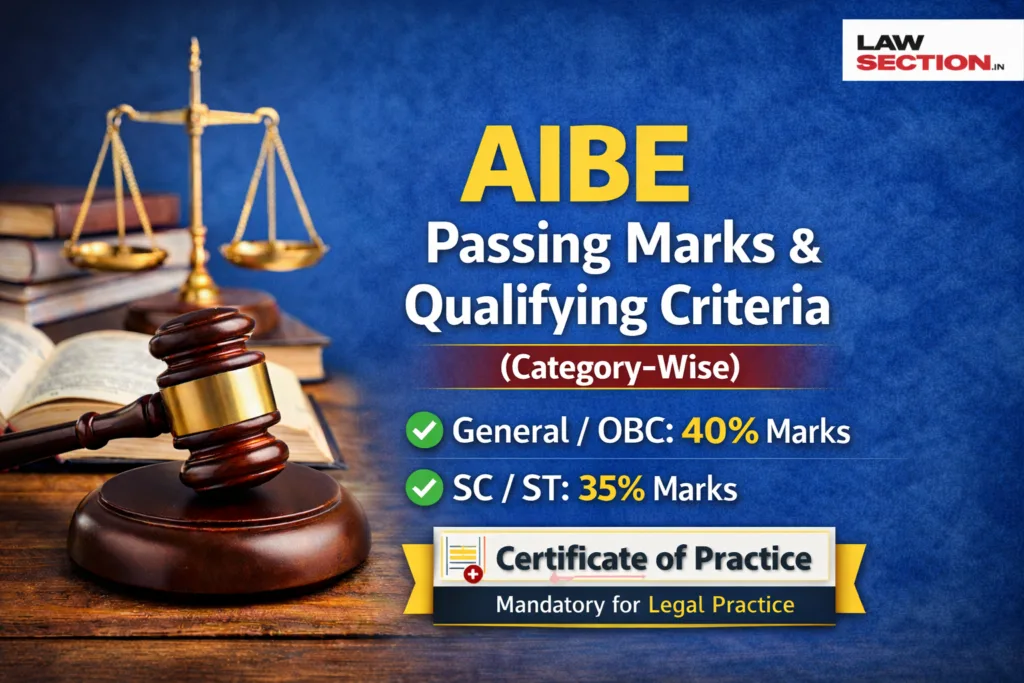
2. What are the qualifying marks for AIBE 2026?
To qualify AIBE 2026:
- General / OBC category: 45%
- SC / ST / PwD category: 40%
There is no negative marking in AIBE. Candidates only need to secure the minimum qualifying marks to obtain the Certificate of Practice (COP).
3.Is AIBE mandatory to practice law in India?
Yes. As per the Bar Council of India (BCI) rules, clearing the All India Bar Examination (AIBE) is mandatory to receive the Certificate of Practice (COP). Without COP, an advocate cannot independently practice in courts in India.
4. How many attempts are allowed in AIBE?
There is no restriction on the number of attempts for AIBE. A candidate can appear multiple times until they qualify and obtain their Certificate of Practice.
5. When will AIBE 2026 registration and exam be conducted?
AIBE XXI (21) registration begins from 11 February 2026, and the examination is scheduled for 7 June 2026, as officially notified by the Bar Council of India.
Final Conclusion
AIBE is not a difficult exam. It becomes difficult only when candidates over-study unnecessary topics.
If you follow this method:
- Study only the BCI syllabus subjects
- Read only the bare acts
- Practice previous year questions
- Revise high-weight subjects first
You will comfortably cross the qualifying marks in AIBE 2026.
Remember, AIBE tests whether you can read and apply law as written in the Bare Act, exactly how a practicing advocate works in court.
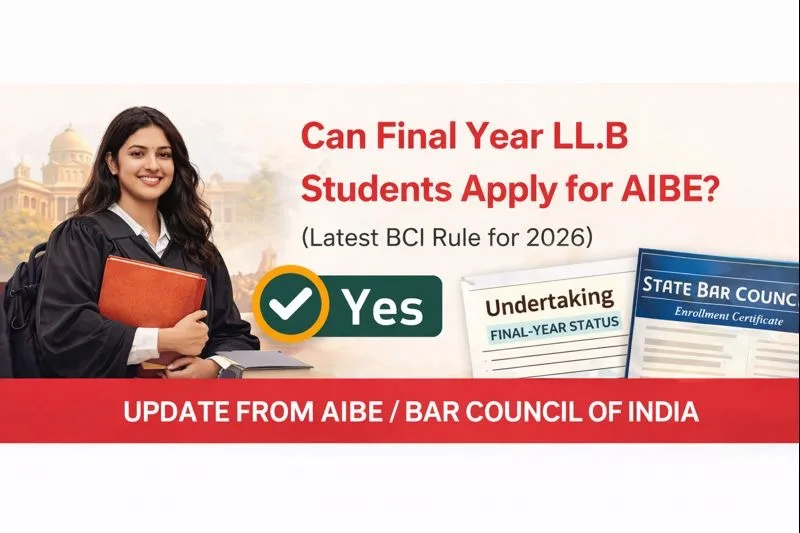
Continue Learning (Previous Guide)
Can Final Year LL.B Students Apply for AIBE? (BCI Rule 2026)
Can final year LL.B students apply for AIBE in 2026? Read the latest BCI/AIBE updated rule, undertaking conditions, and what to do to avoid rejection.
Important AIBE XXI Guides for Exam Preparation
Our editorial team curates these guides after reviewing official exam notifications, admission updates, and verified education sources to help law aspirants make informed decisions. Always cross-check final dates and rules from the official notification of the concerned year.
Editorial & Review Statement
This AIBE Exam 2026 syllabus guide has been carefully prepared after reviewing:
- Official notifications and subject lists released by the Bar Council of India
- Latest AIBE exam patterns and qualifying rules
- Updated legal changes including BNS, BNSS, and BSA
- Previous AIBE question trends and expert analysis
