
UGC NET Law Result Meaning: JRF vs Assistant Professor vs PhD Eligibility Explained
Reviewed by Rajni Bala, Assistant Professor of Law | Academic Review Panel
Last Updated: April 07, 2026
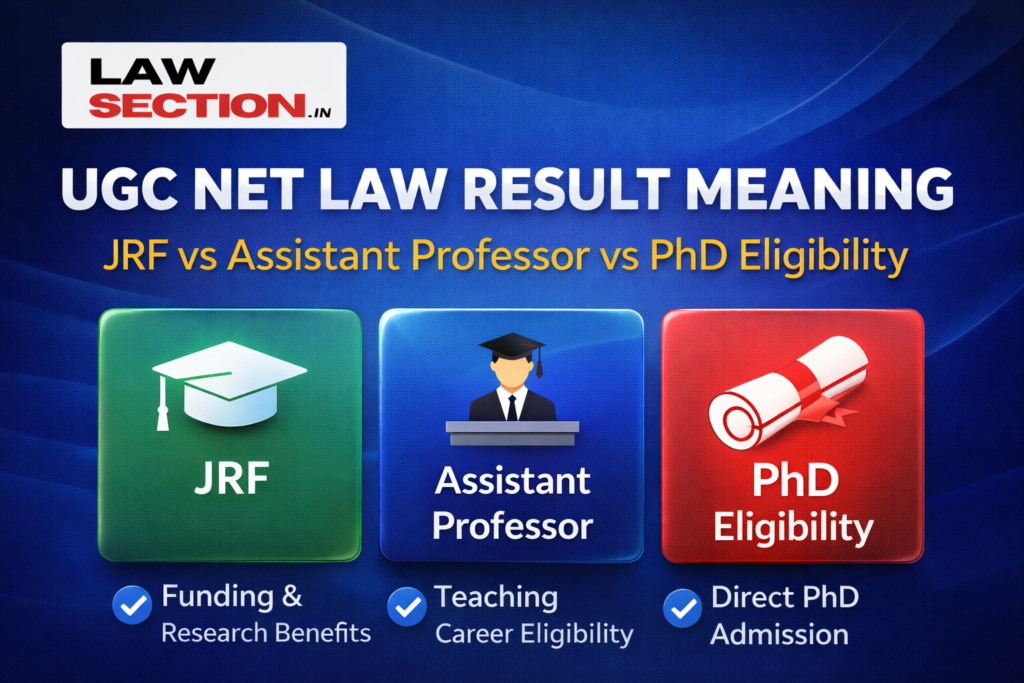
The UGC NET Law result meaning determines whether a candidate qualifies for Junior Research Fellowship (JRF), Assistant Professor eligibility, or PhD admission eligibility. JRF holders receive fellowship funding and research opportunities, while Assistant Professor qualifiers can apply for teaching jobs. Candidates qualifying only for PhD eligibility can pursue doctoral admission without additional entrance tests.
For a complete understanding of syllabus, preparation strategy, and cut-off trends, you should also explore our detailed guide on UGC NET Law to build a strong foundation before analysing your result.
Explore more -> Eligibility Criteria | Syllabus & Pattern | Cut-off | Top NLUs | Preparation Strategy
What Does UGC NET Law Result Mean in 2026?
The UGC NET Law result determines your academic and career eligibility based on merit, category-wise cut-off, and NTA selection criteria.
JRF Qualification
Top-ranked candidates receive financial fellowship + PhD opportunity with national-level merit recognition.
Assistant Professor
Eligible to teach in universities and colleges with lifetime validity under UGC norms.
PhD Eligibility
Qualified candidates can pursue PhD admissions without JRF, subject to university criteria.
Your final result depends on normalized score, category cut-off, and overall ranking as per official NTA guidelines (2026).
UGC NET Law Result 2026 – Quick Understanding
Your UGC NET Law result determines your exact academic position—whether you qualify for research funding, teaching eligibility, or PhD admission.
Top Rankers
Eligible for JRF + Assistant Professor
✔ Research + Monthly Stipend
Mid-Level Rank
Eligible for Assistant Professor only
✔ Teaching Career Path
Qualified Candidates
Eligible for PhD Admission
✔ No Fellowship Included
Selection Basis
Based on cut-off + category + merit
✔ As per NTA 2026 rules
Detailed Explanation of UGC NET Law Result Meaning
The UGC NET Law result determines whether a candidate qualifies for JRF (Junior Research Fellowship), Assistant Professor eligibility, or PhD admission eligibility. Each category defines a different academic and career path based on cut-off marks, merit ranking, and UGC regulations (updated 2026).
JRF Qualification Meaning in UGC NET Law
If your result shows qualification for Junior Research Fellowship (JRF), it is considered the highest academic achievement in UGC NET Law. It not only allows you to pursue research but also provides financial support and strong career advantages.
Key Benefits of JRF Qualification:
- Monthly fellowship (₹31,000–₹35,000 approx. as per UGC norms)
- Direct advantage in PhD admissions in top universities
- Higher preference in academic and research recruitment
- Strong foundation for careers in academia, judiciary research, and policy
The JRF is valid for 3 years for the purpose of PhD admission. During this period, candidates must secure admission in a recognized university or research institution.
Importantly, JRF qualifiers are also automatically eligible for Assistant Professor positions.
Assistant Professor Eligibility Meaning
If your result shows eligibility for Assistant Professor only, it means you have qualified UGC NET but did not meet the higher cut-off required for JRF.
What This Means for You:
- You can apply for teaching positions in universities and law colleges across India
- You are not eligible for fellowship funding (JRF)
- You can still pursue PhD through university admission processes
Assistant Professor eligibility now has lifetime validity, as per the latest UGC regulations (updated till 2026). This makes it a permanent academic qualification for teaching careers.
This category is ideal for candidates who want to build a stable teaching career in law without focusing on funded research.
PhD Admission Eligibility Meaning (New UGC Criteria)
Under recent UGC updates, some candidates qualify only for PhD admission eligibility. This category allows direct entry into research programs without qualifying for JRF or Assistant Professor.
What PhD Eligibility Includes:
- Direct eligibility for admission into PhD programs
- In some universities, exemption from entrance tests (subject to rules)
- No financial support or fellowship under this category
This qualification helps candidates enter research programs faster, but they must arrange their own funding or apply separately for scholarships.
Important Insight:
Your final result category depends on cut-off trends, category reservation, and total candidates appearing. Even a small difference in marks can change your qualification from JRF to Assistant Professor or PhD eligibility.
UGC NET Law Result Outcome – Marks vs Eligibility (2026)
Your UGC NET Law result is not just about marks — it directly determines your career path (JRF, Assistant Professor, or PhD). Below is a practical interpretation of score ranges based on latest cut-off trends and NTA merit logic.
| Score Range (General Approx.) | Eligibility Outcome | What It Means |
|---|---|---|
| 220+ Marks | JRF + Assistant Professor | Top rankers – Eligible for fellowship + PhD + teaching |
| 190–210 Marks | Assistant Professor | Teaching eligibility in universities/colleges |
| 160–180 Marks | PhD Eligibility | Eligible for PhD admission (no fellowship) |
Note: Score ranges vary every year depending on exam difficulty, normalization, and category-wise cut-offs (Updated as per 2026 trends).
If You Score 220+ (Top Tier)
You are among the top merit candidates. You will get JRF + Assistant Professor eligibility, opening doors for funded PhD and academic careers.
If You Score 190–210 (Strong Zone)
You qualify for Assistant Professor. You can directly apply for teaching jobs or pursue PhD for career growth.
If You Score 160–180 (Entry Zone)
You qualify for PhD admission eligibility. However, you will not receive JRF funding — you may reattempt for better rank.
What Should You Do After Seeing Your Result?
- Got JRF? → Immediately plan for PhD + research career
- Only Assistant Professor? → Apply for teaching + consider PhD
- Only PhD eligibility? → Decide between PhD or reattempt for JRF
Your decision at this stage directly impacts your long-term legal academic career.
Common Mistakes Students Make About UGC NET Law Result (Avoid These in 2026)
After the declaration of UGC NET Law results, many aspirants focus only on whether they have “qualified” or not. However, the real meaning of your result lies in its category and implications. Below are the most common mistakes you must avoid.
- Assuming “Qualified” Automatically Means JRF
Many students wrongly believe that clearing UGC NET guarantees JRF. In reality, JRF is awarded only to top-ranking candidates based on higher cut-offs and limited slots.
Always verify your result category clearly—JRF, Assistant Professor, or PhD eligibility. - Ignoring Category-Wise Cut-Off and Reservation Impact
Comparing raw marks with friends or toppers without considering category (General, OBC, SC, ST, EWS) leads to wrong conclusions.
UGC NET results are strictly based on category-specific merit and normalization, not absolute marks. - Misunderstanding Assistant Professor Eligibility Validity
A common myth is that Assistant Professor eligibility expires after a few years.
As per updated UGC norms (valid till April 2026), this qualification has lifetime validity, making it a permanent teaching eligibility. - Underestimating the Value of PhD Eligibility Category
Many candidates ignore this category, assuming it has limited value.
In reality, it allows direct PhD admission, faster entry into research, and long-term academic growth (even without JRF funding). - Not Analyzing Previous Year Cut-Off Trends
Without comparing past trends, students fail to understand whether their score is competitive.
Cut-off analysis helps you decide whether to accept your result or reattempt for JRF improvement. - Taking Immediate Career Decisions Without Strategy
Rushing into PhD admissions or job applications without evaluating options can lead to long-term regret.
Always align your decision with your result category, career goal, and future opportunities. - Ignoring Score Margin and Improvement Potential
Many candidates do not analyze how close they were to the next category (e.g., JRF).
Even a 5–10 mark improvement can upgrade your result significantly—making a reattempt a smart choice. - Ignoring University-Specific PhD Admission Rules
Some candidates assume NET qualification guarantees admission everywhere.
In reality, universities may have additional criteria, interviews, or entrance tests. - Not Seeking Proper Guidance or Mentorship
Many students rely on assumptions or peer advice instead of expert guidance.
Proper understanding of your result can help you maximize opportunities and avoid wrong decisions.
Expert Insight:
A small difference in marks can completely change your academic path—from Assistant Professor to JRF. Always evaluate your result with strategy, not emotion.
What To Do After UGC NET Law Result 2026 (Step-by-Step Strategy Guide)
Clearing UGC NET Law is just the beginning. The real success depends on what you do next. A smart, well-planned approach can help you build a strong academic or professional career in law.
If You Qualified for JRF (Junior Research Fellowship)
If you have secured JRF, you are among the top-ranked candidates in India. This opens doors to funded research, PhD programs, and academic careers.
What You Should Do Immediately:
- Apply for PhD admissions in top universities (NLUs, Central Universities, reputed private institutions)
- Shortlist research areas and prepare a strong research proposal
- Track university PhD notifications (important timelines)
- Keep documents ready (NET certificate, marksheet, research proposal, SOP)
Remember: JRF is valid for 3 years, so timely admission into a PhD program is essential to activate your fellowship benefits.
If You Qualified for Assistant Professor Only
This qualification makes you eligible to teach in universities and law colleges across India, which is a stable and respected career path.
Your next steps:
- Apply for Assistant Professor vacancies (UGC-approved universities & colleges)
- Build a strong academic profile (LLM marks, publications, internships)
- Consider enrolling in a PhD program to strengthen long-term career prospects
- Prepare for interviews and teaching demonstrations
Assistant Professor eligibility has lifetime validity (UGC updated rules 2026), so you can apply anytime without expiry pressure.
If You Qualified for PhD Admission Eligibility Only
This category allows you to directly enter research programs, even without JRF or teaching eligibility.
Strategic actions to take:
- Apply for PhD programs in universities accepting NET-qualified candidates
- Explore universities offering entrance exam exemptions
- Look for alternative funding options (scholarships, university fellowships)
- Choose your specialization carefully (important for long-term career growth)
Since this category does not include financial support, planning funding is crucial before starting your PhD journey.
Should You Reattempt UGC NET Law for Better Results?
Many successful candidates improve their results in the second attempt by focusing on weak subjects and previous year trends.
Smart decisions rule:
- JRF → Go for PhD immediately
- Assistant Professor → Start teaching + consider PhD
- PhD Eligibility → Enter research + plan funding
- Close to JRF → Reattempt strategically
Your UGC NET Law result is not the end—it is a starting point for multiple career paths. Choosing the right strategy based on your result category can define your long-term success in academia, research, or legal education.

Continue Learning (Previous Guide)
Choosing the Right Law College for LLM Abroad?
LLM abroad helps Indian law graduates gain international exposure, specialised legal knowledge, and global career opportunities.
Frequently Asked Questions (FAQs)
Q1. What does JRF mean in UGC NET Law?
JRF means Junior Research Fellowship, allowing candidates to pursue funded PhD programs and research careers with fellowship support.
Q2. Is Assistant Professor eligibility permanent?
Yes. According to latest UGC rules, Assistant Professor eligibility is valid for lifetime.
Q3. Can I pursue PhD without JRF after clearing UGC NET?
Yes. Candidates qualifying Assistant Professor or PhD eligibility can pursue doctoral studies through university admission procedures.
Q4. Does qualifying UGC NET guarantee a teaching job?
No. UGC NET provides eligibility only. Selection depends on university recruitment processes.
Q5. What is the validity of JRF in UGC NET Law?
JRF validity is currently three years from the result declaration date.
Final Conclusion
UGC NET Law results determine whether candidates qualify for research fellowship, teaching eligibility, or doctoral admission benefits. JRF offers maximum academic advantage, while Assistant Professor eligibility opens teaching opportunities. Understanding your qualification category helps you plan your law academic career effectively and strategically.
Related posts UGC NET Law aspirants must explore
Our editorial team curates these guides after reviewing official exam notifications, admission updates, and verified education sources to help law aspirants make informed decisions. Always cross-check final dates and rules from the official notification of the concerned year.


This article is prepared by Lawsection.in Editorial Team after reviewing official exam notifications, National Testing Agency updates, and verified academic sources to ensure accuracy, relevance, and reliability for UGC NET Law aspirants.
